On a freezing evening around 1859, three-year-old Nikola Tesla stroked his black cat Mačak and triggered a shower of crackling sparks across the dark room. That brief static shock launched an obsession that shaped modern electrical engineering.
Today, you can trace Tesla’s childhood spark directly to triboelectric physics, winter indoor humidity, and voltage thresholds that govern your electronics. Understanding what happened in that Croatian cottage helps you protect sensitive devices and manage dry winter air at home.
Here is how a toddler’s curiosity bridged everyday static and global power systems—and what current science reveals about every spark you feel.

The 1859 Winter Evening That Sparked a Scientific Obsession
Eight decades after that winter night, an aging inventor sat down to record the moment that first drew him toward electrical science. In 1939, Nikola Tesla wrote a letter titled A Story of Youth Told by Age to 12-year-old Pola Fotitch.
Pola was the daughter of Constantin Fotitch, the Yugoslav Minister to the United States. Tesla sent the letter alongside the 1939 Calendar of Yugoslavia, which featured an illustration of his childhood home.
In the letter, Tesla recalled being only three years old when the incident occurred. He noted that eighty years had gone by since that night, placing the event around 1859.
Records from Britannica, Wikipedia, and the Tesla Science Center at Wardenclyffe place Tesla’s birth on July 9 or 10, 1856, with July 10 recorded officially. He grew up in Smiljan, a village in the Austrian Empire that is now part of Croatia.
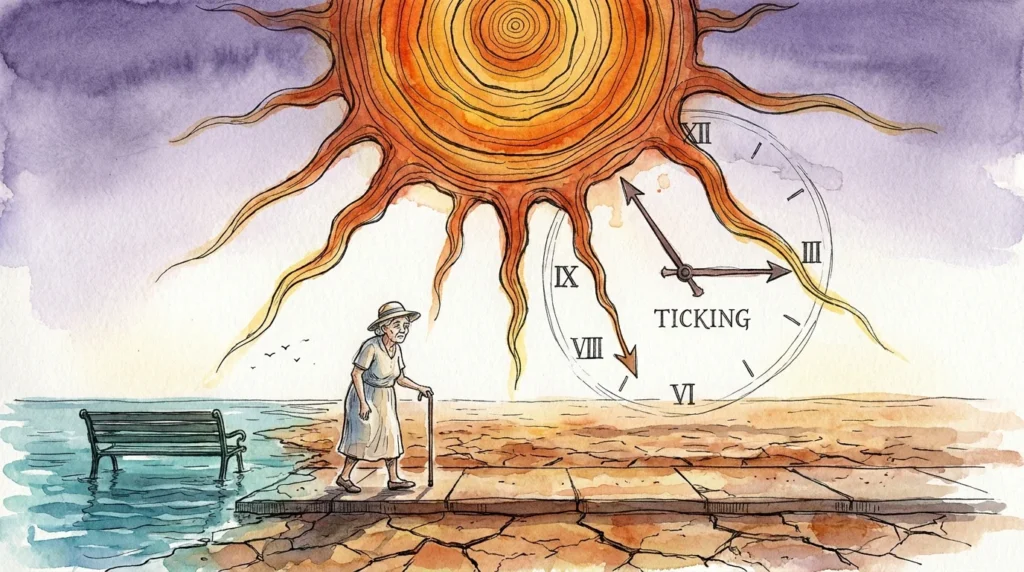
That evening brought an unusually severe, dry winter cold snap to Smiljan. Tesla wrote that the air grew so dry that people walking through snow left a luminous trail behind them.
Even snowballs thrown against obstacles emitted brief flares of light upon impact. Under those extreme atmospheric conditions, static charge accumulated effortlessly on clothing, fur, and snow crystals.
As dusk settled indoors, Tesla began stroking the back of his black cat, Mačak—a name often anglicized as Macak. According to archival copies preserved by the Nikola Tesla Museum, Mačak’s coat suddenly turned into “a sheet of light.”
Tesla’s small hand produced “a shower of crackling sparks” loud enough to carry throughout the house. Startled by the miniature lightning show, his parents reacted from two very different angles.
His father, Milutin Tesla, served as a Serbian Orthodox priest and quickly offered a natural explanation. He told young Nikola, “this is nothing but electricity, the same thing you see on the trees in a storm.”
His mother, Georgina “Đuka” Mandić Tesla, had no formal schooling but was known locally for inventing clever household devices. Concerned about safety inside a timber home, she told her son to stop petting the cat lest he start a fire.
Young Tesla lay awake wondering about the link between his pet’s fur and storm clouds overhead. He recalled asking himself, “Is nature a gigantic cat? If so, who strokes its back? It can only be God.”
Writing eighty years later in 1939, Tesla admitted that he still asked himself, “What is electricity?” You can apply that same disciplined wonder whenever you spot an unexpected physical effect at home.
Instead of brushing off a winter shock as an annoyance, treat it as an observable signal of surface charge, air dryness, and voltage potential. Every static snap you feel carries real data about your indoor environment.
How Petting a Cat Generates Thousands of Volts
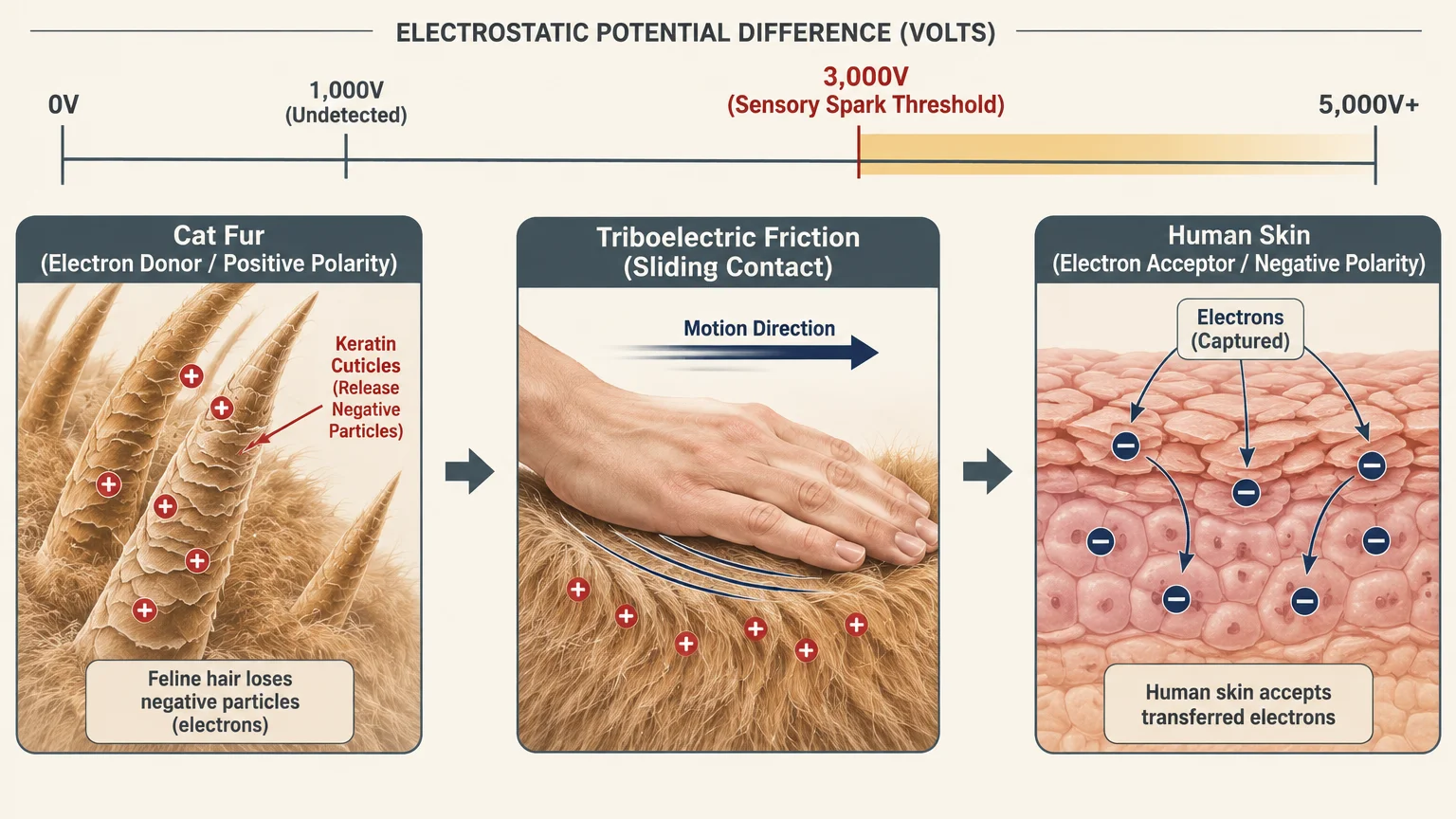
When you run your palm down a cat’s back, you trigger the triboelectric effect—a name derived from the Greek word tribo, meaning to rub. Contact and sliding friction between two different materials transfer electrons across their shared boundary.
One surface ends up holding extra electrons with a net negative charge, while the other loses electrons and becomes positively charged. Cat fur sits near the positive end of the triboelectric series, so it readily sheds electrons when rubbed against skin or fabrics.
For centuries, scientists knew that rubbing surfaces creates static electricity without fully explaining why sliding matters so much. In September 2024, materials scientist Laurence Marks and colleagues at Northwestern University published a sharper mechanical explanation building on their 2019 research.
Their findings show that rubbing deforms microscopic surface protrusions differently at the front edge and back edge of a sliding motion. That asymmetric deformation creates an electrical charge differential and voltage that drives triboelectric charging.
Once Mačak’s coat and Tesla’s hand held opposite charges, the surrounding dry air acted as an electrical insulator until the voltage climbed high enough to break through. Under Paschen’s law, cited by the National Institute of Standards and Technology, the minimum sparkover voltage in air is 327 volts.
However, you will not see a visible glow or hear a crisp snap at that bare threshold. At normal atmospheric pressure, noticeably visible sparks or glows generally require 500 to 700 volts or more.
Your fingertips are even less sensitive than your eyes when it comes to detecting static electricity. According to the Library of Congress, the ESD Design and Analysis Handbook, and Smart Fog data, a human cannot feel a static shock below roughly 2,000 to 3,000 volts.
Because Tesla both saw a sheet of light and heard loud crackles across the house, the discharge off Mačak easily cleared several thousand volts. Everyday shocks from walking across carpets or peeling dry fabrics routinely climb up to 25,000 volts, as documented in Spark: The Life of Electricity and the Electricity of Life.
Dry air at standard temperature and pressure breaks down at roughly 33 kilovolts per centimeter between spherical electrodes. Across a tiny millimeter gap between your fingertip and a cat’s ear, a few thousand volts is more than enough to ionize air into a spark.
That threshold creates a hidden trap for anyone working on computers, cameras, or smart appliances at home. Smart Fog notes that just 10 to 100 volts can damage sensitive semiconductor electronics long before you feel a thing.
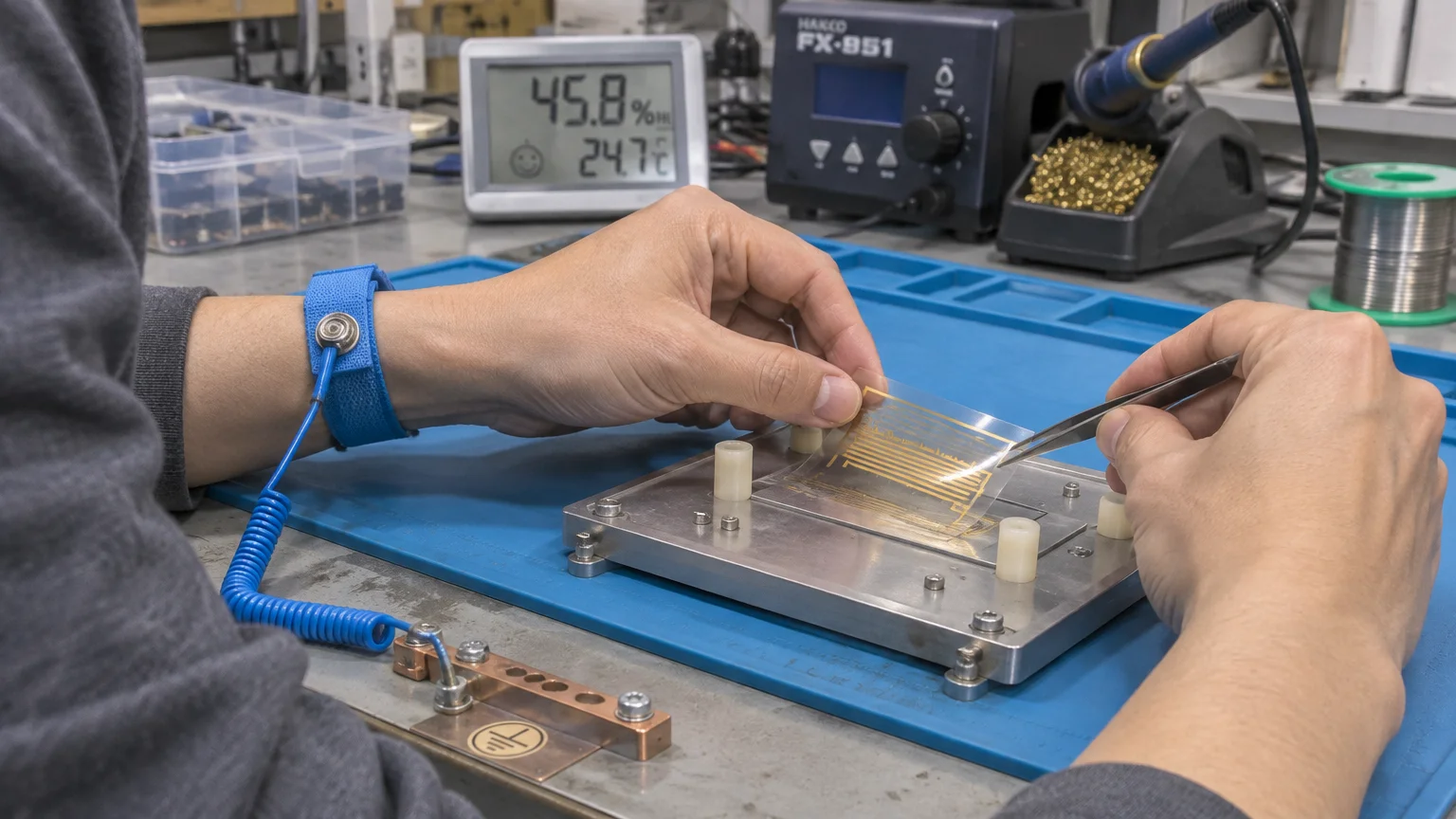
To protect your gear, always touch a grounded metal surface—such as an unpainted computer chassis plugged into a grounded outlet—before handling circuit boards or memory sticks. Avoid assembling or upgrading electronics while sitting on carpeted floors or wearing wool sweaters.
When it comes to petting your own cat during dry weather, you can prevent sharp nose-to-nose zaps with one quick habit. Touch a metal lamp base or doorknob first to bleed excess charge from your body before reaching for your pet.
You might wonder why a 20,000-volt static zap stings for a split second without harming you or your cat. As the Library of Congress and Spark explain, static discharges carry an extremely tiny total charge and electric current that lasts only a fraction of a second.
Why Winter Heating Turns Your Home Into a Static Trap
Tesla’s childhood spark did not happen during a humid summer afternoon; it happened during a severe winter cold snap. Understanding why cold air fuels static buildup gives you direct control over indoor comfort and equipment safety.
Cold outdoor air holds very little absolute water vapor compared with warm air. When your home’s furnace draws freezing outdoor air inside and heats it to room temperature, relative humidity plummets.
According to Smart Fog and Condair UK, forced-air heated buildings routinely drop to 10 percent to 20 percent relative humidity during winter. At those desert-like levels, your skin, carpets, and pet’s fur become prime electrostatic generators.
In more humid rooms, moisture in the air deposits an invisible, microscopic film of water across everyday surfaces. That thin conductive layer lets stray electrons leak away harmlessly before voltage can build to sparkover levels.
Once relative humidity drops below 40 percent, insulating surfaces lose that conductive water film and begin hoarding electric charge. As Smart Fog, Condair UK, and Strong Heating & Cooling note, static buildup tapers off above roughly 40 percent relative humidity and largely disappears around 55 percent.
That physics curve creates a tempting mistake: cranking a room humidifier as high as possible to eliminate every shock. Pushing indoor moisture too far trades static sparks for mold spores, dust mites, and warped woodwork.
The U.S. Environmental Protection Agency advises keeping indoor relative humidity below 60 percent, and ideally between 30 percent and 50 percent. The EPA specifically warns against using a home humidifier to push relative humidity above 50 percent to prevent mold and biological growth.
You can hit the sweet spot between static relief and healthy air by using a simple digital hygrometer—a tool costing only a few dollars. Aim to maintain your living space between 35 percent and 45 percent relative humidity throughout winter.
At 40 percent to 45 percent relative humidity, you cross above the threshold where insulating fabrics hoard multi-thousand-volt charges. At the same time, you stay safely under the EPA’s 50 percent humidifier ceiling.
If you cannot humidify an entire house, focus on the rooms where you handle electronics or spend time with pets. Even running a small cool-mist unit in a home office cuts the risk of silent 10-to-100-volt semiconductor damage.
Swap out synthetic fleece throws for cotton blankets on winter couches, because cotton retains trace surface moisture far better than polyester. When Mačak-level cold snaps arrive, simple moisture management keeps both your hardware and your pets comfortable.
From Amber and Cat Fur to 300-Million-Volt Lightning
When Milutin Tesla told his three-year-old son that Mačak’s sparks were the same force seen on trees during a storm, he echoed a scientific breakthrough forged over two millennia. Human understanding of electricity began with humble static attraction long before anyone mastered power grids.
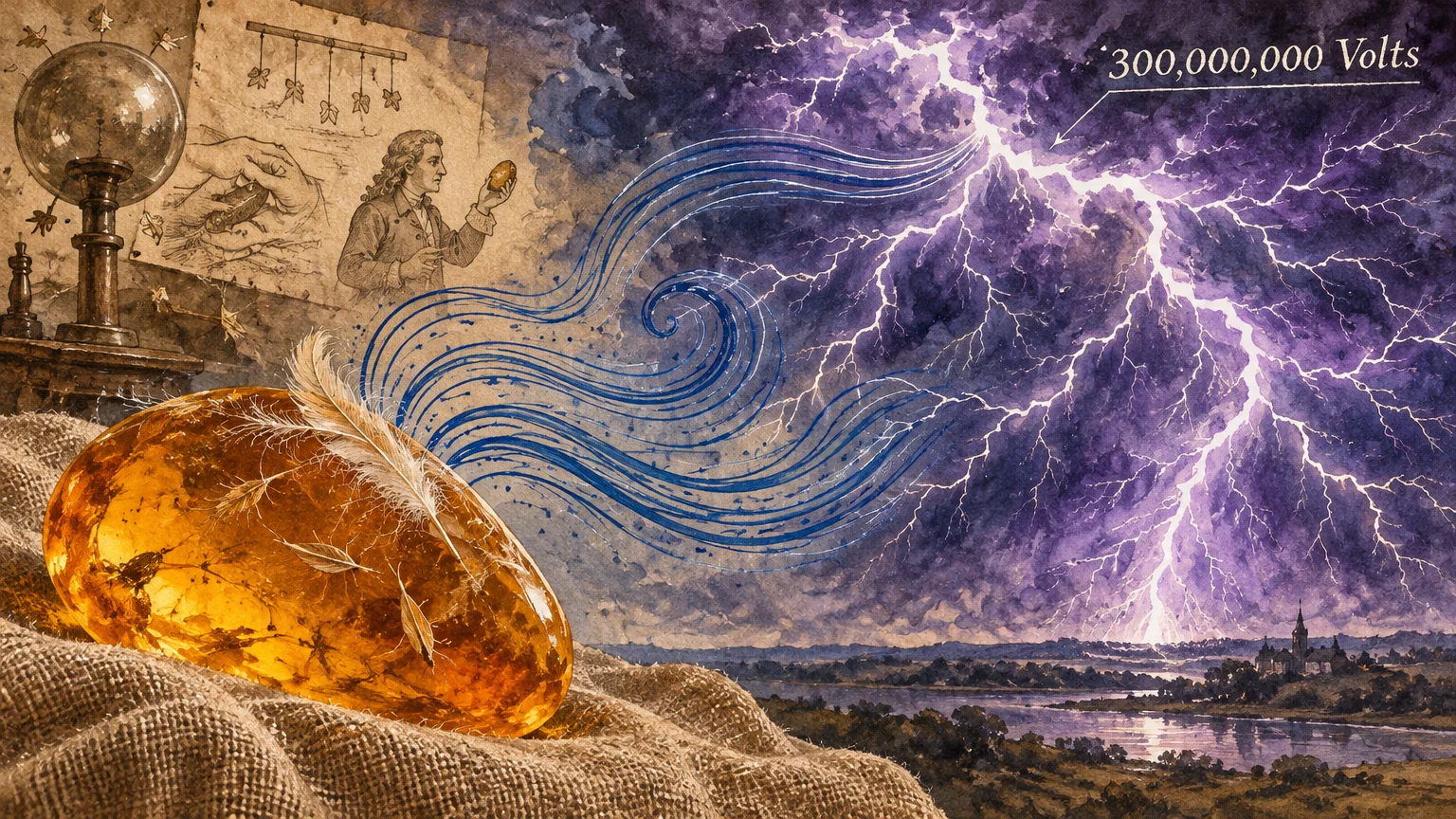
Around 600 BCE, Greek philosopher Thales of Miletus observed that rubbing amber with fur enabled the fossilized resin to pull in dust and light fibers. ScienceAlert notes that this simple experiment marked one of history’s earliest recorded electrical observations.
More than two thousand years later, English physicist William Gilbert gave the phenomenon a formal scientific name. In his 1600 treatise De Magnete, Gilbert coined the Neo-Latin word electricus—meaning of amber or like amber—from the Latin electrum and Greek ēlektron.
The English word “electricity” first appeared in print in 1646 inside Sir Thomas Browne’s work Pseudodoxia Epidemica, according to the Oxford English Dictionary and The Saturday Evening Post. Even then, scholars mostly viewed static sparks as parlor curiosities separate from weather.
That divide began closing in 1708, when Dr. William Wall noticed that sparks snapping off charged amber resembled miniature flashes of lightning. Between 1749 and 1752, Benjamin Franklin conducted experiments establishing that lightning and laboratory electricity share identical physical properties.
In 1752, before Franklin’s famous kite test, French researcher Thomas-François Dalibard drew sparks from a passing thundercloud near Paris using a 40-foot—or 12-meter—iron rod. Dalibard’s trial confirmed that sky-high storms and tabletop static obeyed the same laws.
Yet comparing a cat’s coat to a thundercloud highlights why scale and current matter far more than raw voltage alone. According to NOAA and the U.S. National Weather Service, a typical lightning flash delivers roughly 300 million volts and 30,000 amps.
That colossal surge heats surrounding air to between 50,000 degrees Fahrenheit and 54,000 degrees Fahrenheit—about 30,000 degrees Celsius—making a lightning channel roughly five times hotter than the Sun’s surface at around 10,000 degrees Fahrenheit. By comparison, standard U.S. household outlets carry 120 volts and 15 amps.
Do not let the lower voltage of wall current lull you into underestimating household power. As NOAA and the National Weather Service emphasize, as little as 0.1 amp flowing through the human body can be fatal.
Here is the practical lesson for your daily safety: voltage measures electrical pressure, while amperage measures flow and energy delivery. A 20,000-volt spark off your cat carries negligible amperage for microseconds, whereas a sustained 120-volt outlet can push lethal current continuously.
Never touch exposed household wiring, and follow strict storm precautions whenever thunder roars nearby. Respecting the gap between harmless triboelectric sparks and sustained high-current circuits keeps curiosity safe.
Scaling a Childhood Question Into 311 Global Patents
The puzzle Milutin Tesla handed his son in Smiljan—figuring out what electricity actually is—followed Nikola Tesla across continents and decades. In 1884, Tesla immigrated to the United States, entering an industrial landscape hungry for reliable electrical transmission.
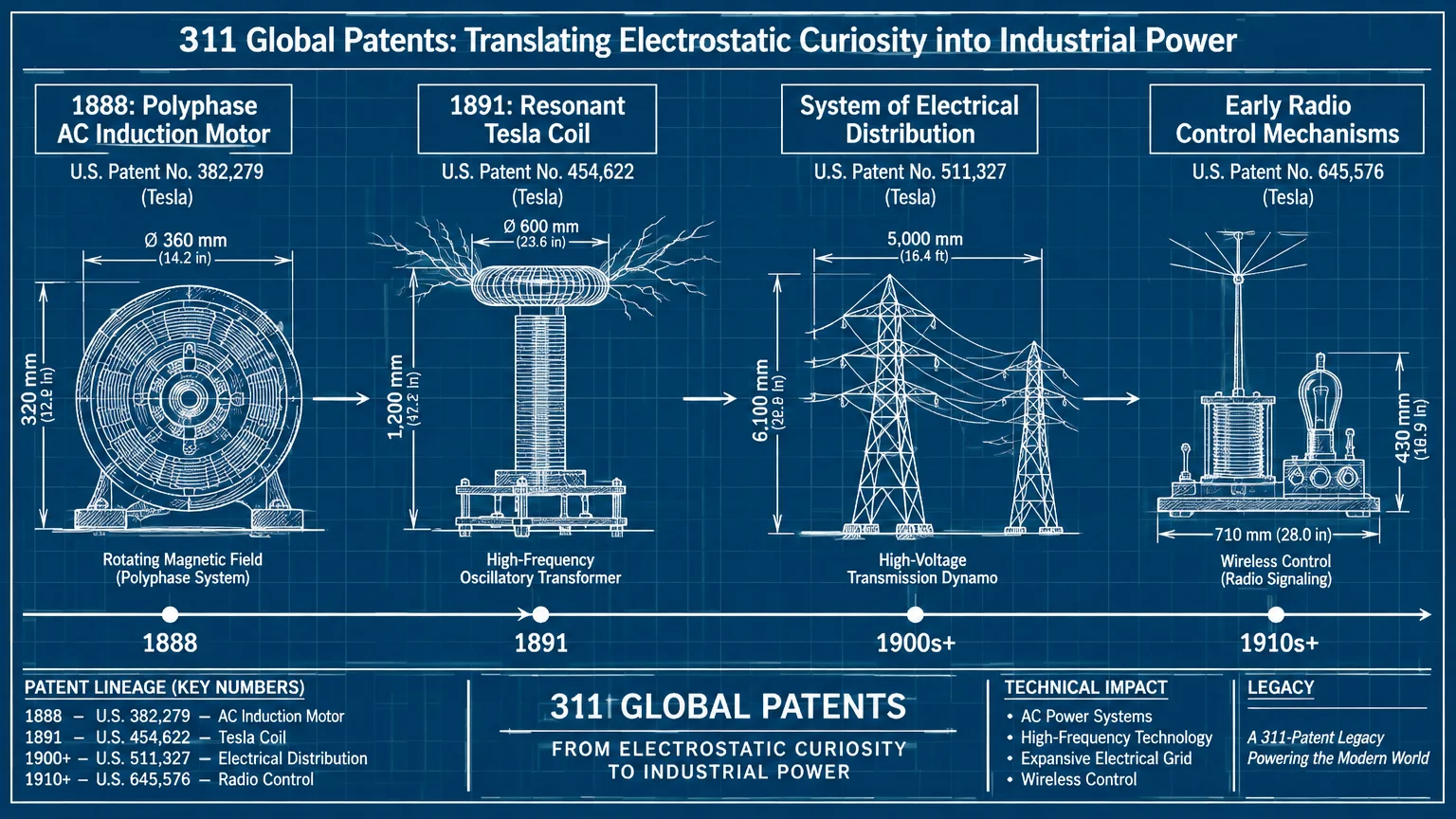
According to Britannica and Wikipedia, Tesla became a naturalized U.S. citizen on July 30, 1891. That same year, he invented the Tesla coil, a resonant transformer circuit built to generate high-voltage, high-frequency alternating current.
In a sense, the Tesla coil engineered artificial indoor lightning—turning the tiny crackling discharges he once pulled from Mačak’s coat into controlled arcs used to study radio transmission and illumination. The same physics of air breakdown and spark thresholds he met at age three sat at the heart of his laboratory work.
Catalogs from the Nikola Tesla Museum in Belgrade show just how relentlessly he translated curiosity into documented inventions. Tesla secured at least 112 registered U.S. patents, spanning from Patent No. 334,823 in 1886 to Patent No. 1,655,114 in 1928.
Beyond the United States, he held 199 patents across 26 other countries, bringing his verified total to at least 311 patents across 27 nations. Historians commonly summarize this output as roughly 300 patents worldwide—a portfolio entirely separate from the corporate patents of modern automaker Tesla, Inc.
Global science later embedded his surname into the fundamental language of physics. As noted by Nowotwory Journal of Oncology, the International System unit of magnetic flux density is named the tesla, abbreviated with a capital T.
Tesla died on January 7, 1943, in New York City at age 86, leaving behind alternating-current breakthroughs that still power modern grids. Yet just four years before his death, his 1939 letter to Pola Fotitch revealed that his foundational wonder remained intact.
Even today, physicists and engineers debate the best ways to handle the exact triboelectric force that charged Mačak’s fur. Cleanroom engineers spend fortunes suppressing triboelectric buildup so tiny invisible arcs do not ruin microchips.
Meanwhile, materials researchers explore how sliding friction might harvest small amounts of mechanical motion for low-power sensors. As Northwestern University’s 2024 work demonstrates, scientists are still refining the microscopic rules behind rubbing two everyday surfaces together.
You can mirror Tesla’s approach in your own work or hobbies without owning a high-voltage lab. Keep a small notebook of strange physical behaviors you notice around the house, test one variable at a time, and check what peer-reviewed science already knows.
Frequently Asked Questions About Tesla’s Cat Story and Static Electricity
When did Nikola Tesla’s cat incident happen, and how do historians verify it?
Tesla stated in his 1939 letter A Story of Youth Told by Age that he was three years old and that eighty years had passed, placing the event around 1859. Born in July 1856 in Smiljan, he grew up during the era reflected in the 1939 Calendar of Yugoslavia illustration.
Historians verify the account through the primary 1939 letter written to 12-year-old Pola Fotitch, daughter of Yugoslav Minister Constantin Fotitch. Archival documentation curated by the Nikola Tesla Museum preserves Tesla’s exact descriptions of Mačak, the snow flares, and his parents’ reactions.
Because the story comes from Tesla’s own memory eighty years later, researchers treat the exact dialogue as personal recollection rather than a contemporaneous 1859 diary entry. However, the atmospheric conditions and static behavior align closely with modern physics.
Where can you inspect Tesla’s original archives and patent records?
You can explore Tesla’s personal papers, correspondence, and verified patent tallies through the Nikola Tesla Museum in Belgrade, which catalogs his 112 U.S. patents and 199 foreign patents. Many U.S. patent filings between 1886 and 1928 are also accessible through public patent databases.
For biographical timelines covering his 1884 arrival in the United States, his July 30, 1891 naturalization, and his 1891 Tesla coil invention, Britannica and the Tesla Science Center at Wardenclyffe provide vetted summaries. Checking primary museum catalogs helps you separate verified patents from internet myths.
How does static physics affect modern electronics and indoor spaces today?
Dry indoor air between 10 percent and 20 percent relative humidity turns carpets, chairs, and clothing into charge reservoirs. While you need roughly 2,000 to 3,000 volts to feel a sting, just 10 to 100 volts can silently destroy sensitive semiconductor chips.
Industries and homeowners rely on humidity control and grounding straps to stop silent electrostatic damage before it occurs. Keeping living spaces between the EPA-recommended 30 percent and 50 percent relative humidity balances static suppression against mold prevention.
How can you follow ongoing discoveries in triboelectric science?
Watch university materials science announcements—such as Northwestern University’s September 2024 report on asymmetric sliding deformation—for updates on how surface physics generates charge. Researchers are actively testing how microscopic textures alter electron transfer during friction.
You can also track standards from the National Institute of Standards and Technology on Paschen’s law and electrical breakdown in gases. Following NOAA and National Weather Service educational portals helps you stay current on atmospheric lightning data.
What Comes Next for Triboelectric Science and Everyday Safety
Triboelectric research has entered a more precise mechanical era following the 2024 discovery linking charge transfer to asymmetric deformation of microscopic surface peaks. Materials teams can now design coatings and textures with far better control over whether sliding surfaces hoard or shed electrons.
That progress promises dual real-world payoffs over the coming years. Semiconductor factories and dry-climate facilities gain smarter anti-static surfaces, while engineers studying friction-based energy harvesters gain clearer blueprints for small self-powered sensors.
For your own routine, you do not need cutting-edge coatings to put Tesla’s childhood lesson to work tonight. Place a digital hygrometer near your thermostat and aim for 35 percent to 45 percent relative humidity during winter cold snaps.
Stay under the EPA’s 50 percent humidifier cap to guard against mold while staying above the 40 percent static threshold. Ground yourself on a metal fixture before opening a laptop or stroking your cat after crossing a dry carpet.
Most of all, keep asking the simple question that stayed with Nikola Tesla for eighty years—what is electricity, and how does it behave right in front of you? That single habit turned a freezing evening with a black cat into a legacy that still lights the world.