
Breaking Hook: Redefining Our Place in the Cosmos
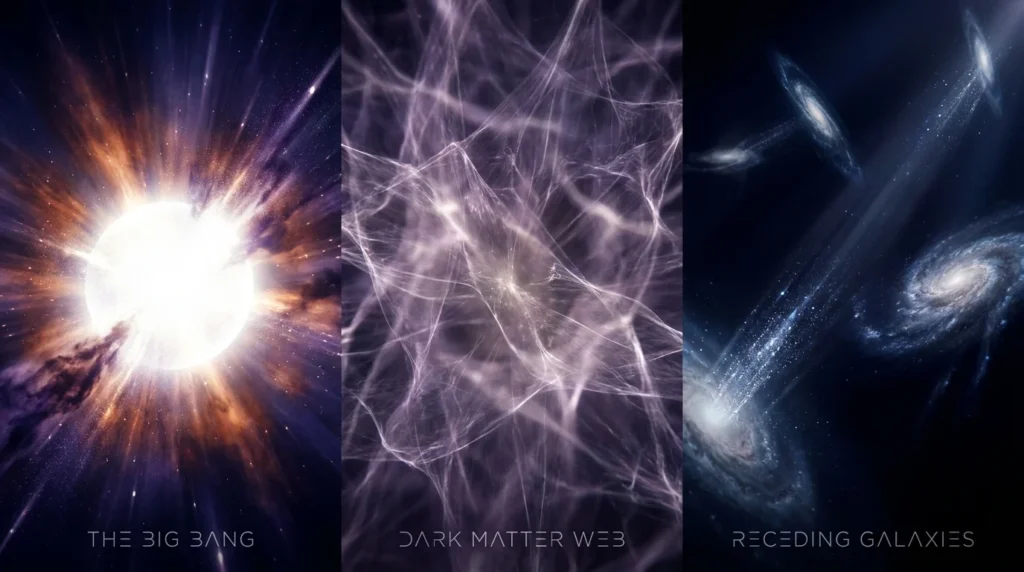
Looking up at the night sky, you might see a static canvas, but modern astrophysics reveals a dynamic, expanding cosmos. Over the past century, researchers shattered our fundamental understanding of the universe. From ripples in the fabric of spacetime to ancient light from the dawn of time, these seven space discoveries transformed astronomy from speculative philosophy into a rigorous, data-driven science. Understanding these milestones gives you a deeper appreciation for your place in the universe. These are verified, peer-reviewed realities dictating the physical laws governing our existence.
1. The Accelerating Expansion of the Universe
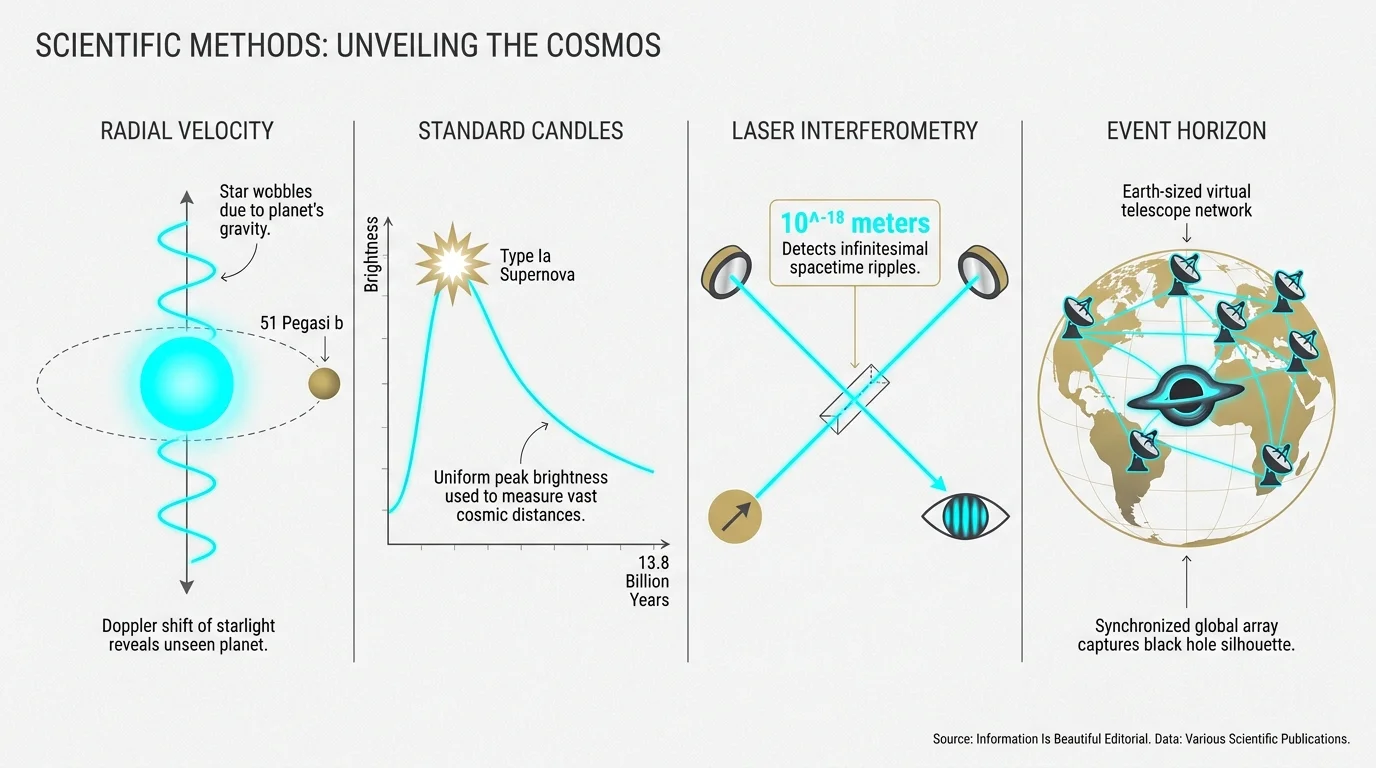
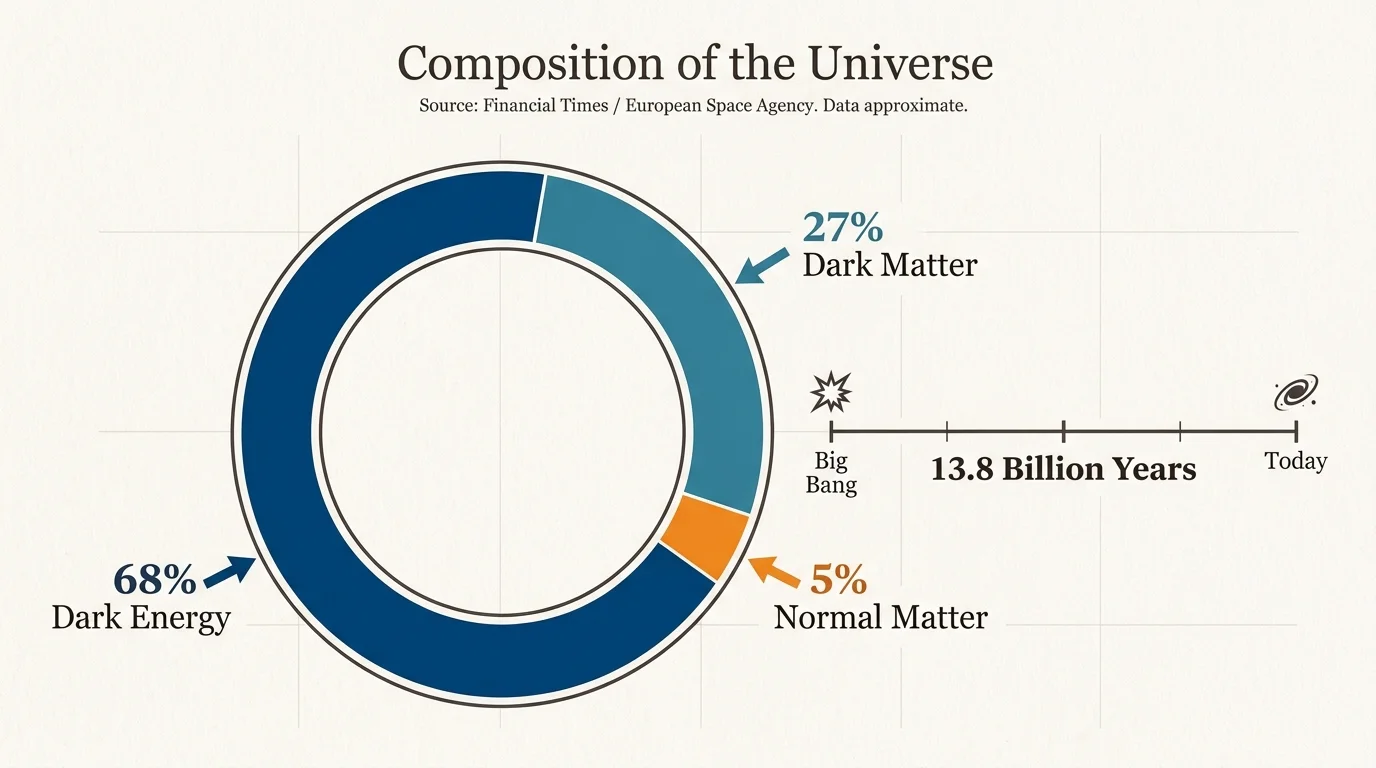
In the late 1990s, astronomers realized the universe expands at an accelerating rate. The High-Z Supernova Search Team and the Supernova Cosmology Project observed distant Type Ia supernovae. These stellar explosions act as standard candles for measuring immense distances. Researchers found these supernovae were dimmer than expected, indicating they were further away than gravity mathematically allows. This peer-reviewed breakthrough forced physicists to propose dark energy, a mysterious repulsive force comprising roughly sixty-eight percent of the universe. You can see the ongoing impact of this discovery today as dark energy drives massive funding initiatives globally.
2. The Cosmic Microwave Background
You cannot fully comprehend the Big Bang without understanding the cosmic microwave background. Discovered accidentally by Arno Penzias and Robert Wilson in 1964, this faint glow of microwave radiation permeates all observable space. It represents the residual heat from the fiery birth of the universe. Later, dedicated space missions mapped this ancient radiation with unprecedented precision. The data from the Planck mission confirmed our standard cosmological model and confidently pegged the age of the universe at 13.8 billion years. This baseline provides the context needed to evaluate new claims about cosmic origins.
3. The First Exoplanet Around a Sun-Like Star
Before 1995, planetary systems outside our solar system remained theoretical constructs. That paradigm changed when Michel Mayor and Didier Queloz detected 51 Pegasi b, a Jupiter-mass planet orbiting a distant main-sequence star. They utilized the radial velocity method, measuring the tiny wobble induced in the host star by the gravitational tug of the orbiting planet. This observation revolutionized exoplanet science and proved that our solar system is not a unique anomaly. Since that pivotal night, dedicated space missions have confirmed over five thousand exoplanets, radically shifting how you think about extraterrestrial life.
4. Gravitational Waves Rippling Through Spacetime
Albert Einstein predicted gravitational waves in 1916, but they remained undetected for a century. In 2015, the Laser Interferometer Gravitational-Wave Observatory successfully recorded spacetime ripples generated by two colliding black holes. This marvel required measuring a physical distance change thousands of times smaller than a proton. The verification process was incredibly stringent, leading to a seminal paper published in Physical Review Letters. For you, this milestone means scientists now possess a completely new way to observe the universe—listening to gravity instead of just looking at light.
5. The First Direct Image of a Black Hole
Because black holes trap all light, they seem impossible to photograph. However, in 2019, the Event Horizon Telescope collaboration changed history by capturing the dark shadow of the supermassive black hole positioned at the center of the Messier 87 galaxy. This unprecedented feat required linking radio observatories across the globe to create a synchronized, Earth-sized virtual telescope. Researchers processed petabytes of raw data using novel imaging algorithms to reconstruct the glowing ring of superheated gas. The published results in The Astrophysical Journal Letters provided you with the first visual proof of these extreme cosmic engines.
6. Ancient Water on Mars
For centuries, humans wondered if Mars ever harbored life. While we have not found biological organisms, robotic explorers proved the Red Planet once contained liquid water. NASA rovers, particularly Curiosity and Perseverance, deeply analyzed sedimentary rock layers and detected specific minerals that only form in the direct presence of water. Curiosity drilled into the Martian crust, performing on-site chemical analysis confirming Gale Crater was once a habitable lake environment. This ongoing planetary research shapes strict biological protection protocols and helps you understand the harsh realities of potential future human colonization.
7. Earliest Galaxies Revealed by the James Webb Space Telescope
The launch of the James Webb Space Telescope provided an unparalleled look into the cosmic dawn. By peering deeply into the infrared spectrum, the telescope cuts through obscuring cosmic dust and captures light physically stretched by the expansion of the universe. In its first deep-field images, researchers identified massive galaxies that existed just a few hundred million years after the Big Bang. These mature structures openly defied existing galaxy formation models. Detailed preprints covering these early galaxies flooded the arXiv repository, sparking fierce debates among astrophysicists regarding exactly how rapidly matter coalesced in the infant universe.
Method and Results: How We Uncovered the Cosmos
Understanding how scientists verify these discoveries gives you confidence in the underlying facts. Each of these astronomical milestones relied on aggressively pushing the extreme limits of observational technology and rigorously applying strict statistical analysis. For gravitational waves, physicists utilized precise laser interferometry over kilometers-long vacuum tubes, ensuring they accounted for local seismic noise or thermal interference. Similarly, photographing a black hole directly required Very Long Baseline Interferometry, using atomic clocks to synchronize massive data streams from isolated facilities ranging from Antarctica to Spain.
The peer review system firmly remains the cornerstone of all these official announcements. Independent research teams continually attempt to replicate the findings or locate potential flaws in the data processing. This aggressive, self-correcting mechanism strongly ensures that when a space agency officially announces a breakthrough, the statistical confidence leaves almost no room for alternative explanations. Researchers typically wait until their data exceeds the gold standard of five sigma before claiming a true discovery. Scientists readily acknowledge remaining uncertainties. Calculating the exact expansion rate of the modern universe—a persistent conflict known as the Hubble tension—remains a highly active area of investigation strongly funded by the National Science Foundation and the Department of Energy.
Applications and Debate: What These Breakthroughs Mean for You
While abstract astrophysics might seem disconnected from your daily life, the extreme technologies developed to track these cosmic phenomena directly impact modern society. The highly complex algorithms specifically designed to rapidly process the massive datasets from the Event Horizon Telescope have successfully advanced medical imaging techniques, directly improving modern MRI and CT scans. Furthermore, the push to build highly sensitive sensors for deep space telescopes drives lucrative innovations in digital camera technology and semiconductor manufacturing.
Despite the broad scientific consensus on these seven discoveries, fierce debate constantly fuels the next critical generation of research. The fundamental nature of dark matter and dark energy easily remains one of the most significant controversies in modern physics. Some prominent researchers confidently argue that our current understanding of gravity requires a fundamental mathematical modification, challenging Einstein’s general relativity on a massive cosmic scale. When you read news articles about the James Webb Space Telescope unexpectedly finding impossibly old galaxies, you are actively witnessing this messy scientific debate playing out in real time. Cosmologists must quickly determine if their existing models of early star formation are fundamentally flawed or if the ancient universe contained hidden variables yet to be quantified.
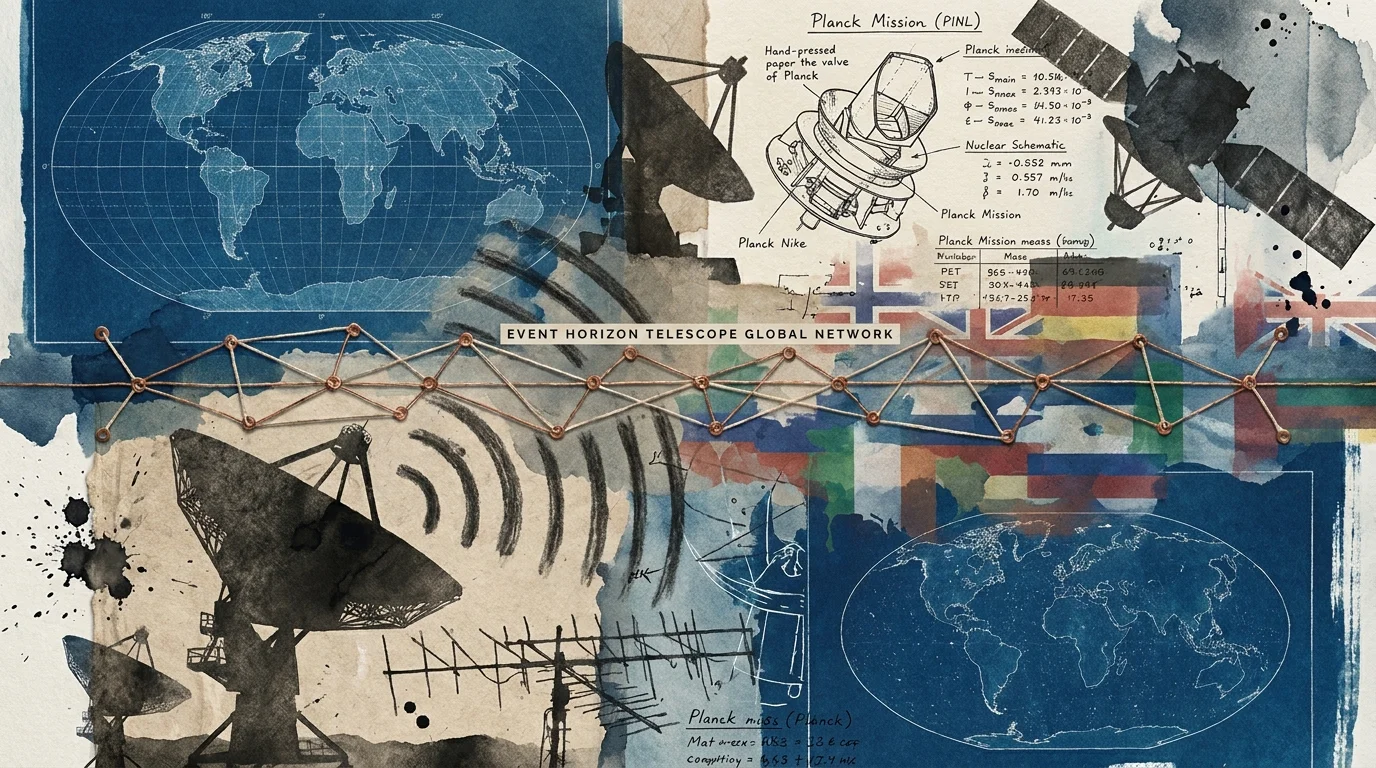
Global Context: Geopolitics and Worldwide Collaboration
Deep space exploration is inherently tied to complicated global geopolitics and vast international collaborations. No single modern nation possesses the massive funding or the widespread geographical footprint required to pull off projects like the Event Horizon Telescope. The James Webb Space Telescope perfectly represents a massive joint effort between NASA, the European Space Agency, and the Canadian Space Agency, powerfully showcasing how pooled international resources consistently yield unprecedented, globally shared scientific returns.
The geopolitical landscape of space exploration is rapidly shifting. Emerging space powers actively deploy their own independent lunar rovers and advanced orbital observatories, dramatically increasing both international competition and cautious cooperation. This emerging multi-polar environment directly impacts how you access scientific data, as national security interests and proprietary technology safeguards sometimes restrict the open sharing of highly advanced aerospace technology.
Furthermore, the rise of commercial spaceflight heavily complicates the broader ethical landscape. As wealthy private entities launch massive mega-constellations of low-orbit satellites, ground-based astronomers strongly face rapidly increasing light pollution that severely threatens deep-sky observations. Successfully balancing the raw economic drive of the new space economy with the crucial preservation of our dark, pristine skies remains a hotly debated challenge for international regulatory bodies.
FAQ: Your Questions About Exploring the Universe
How long does it realistically take for a major space discovery to be confirmed?
The confirmation timeline varies depending heavily on the complexity of the raw data. While an initial observation might happen overnight, cautious researchers routinely spend months ruling out instrumental errors before formally publishing. The LIGO team nervously spent several months intensely verifying their very first gravitational wave signal to absolutely ensure it was not a terrestrial anomaly or a software glitch.
Where can you easily access the raw data from these prominent space missions?
Major international space agencies legally mandate open access to their taxpayer-funded astronomical data. You can freely download fully processed images directly from the Mikulski Archive for Space Telescopes or deeply explore European Space Agency science databases. This transparent data policy empowers citizen scientists to actively verify published findings or discover entirely new cosmic phenomena hidden in the archives.
How do these profound space discoveries actively impact the commercial tech industry?
The incredibly rigorous demands of surviving the vacuum of space force aerospace engineers to invent wildly new composite materials, secure communication protocols, and efficient power systems. These costly innovations inevitably trickle down to the commercial tech sector, enhancing your smartphone camera sensors and global GPS networks. Private companies actively leverage this advanced aerospace technology to build vastly better terrestrial weather tracking systems.
How can you best stay updated on the absolute latest astronomical breakthroughs?
Actively following official space agency feeds and reputable open-access pre-print servers provides the absolute most direct access to cutting-edge science. Eager researchers frequently post their early, unedited findings to these digital repositories while the papers undergo slow, formal peer review. Tracking these primary sources lets you watch the scientific process boldly unfold long before discoveries hit mainstream university textbooks or evening news broadcasts.
Forward Track: Upcoming Missions and Next-Generation Data
The rapid pace of profound space discoveries will only accelerate over the next decade. You should closely watch for the upcoming launch of the Nancy Grace Roman Space Telescope, an observatory which will easily provide a massive panoramic field of view to deeply study dark energy and actively map the massive distribution of distant galaxies on an unprecedented scale. Meanwhile, the highly anticipated European Space Agency’s Laser Interferometer Space Antenna will soon boldly take low-frequency gravitational wave detection directly into stable orbit, allowing eager scientists to clearly hear the faint murmurs of colliding supermassive black holes located near the edge of the observable early universe.
Ground-based astronomy is also preparing for a historic upgrade. The Extremely Large Telescope, currently under complex construction in the high deserts of Chile, will successfully gather vastly more light than all existing major research telescopes firmly combined. When these immense, next-generation optical observatories finally power on, they will aggressively test the very boundaries of our known physical laws. They will actively search for compelling atmospheric biosignatures on distant rocky exoplanets and boldly attempt to resolve the frustrating mysteries of invisible dark matter. The expanding universe clearly holds countless ancient secrets, and the powerful technological tools required to finally uncover them are remarkably within our grasp.