Imagine surviving lethal radiation, regenerating a severed limb, or sleeping for six months without losing muscle. You no longer have to look at comic books to find these abilities, because scientists are actively uncovering them in the animal kingdom to revolutionize human medicine. By mapping the genetic blueprints of earth’s most resilient creatures, researchers hope to solve humanity’s toughest medical challenges. From naked mole rats that resist cancer to hibernating bears that avoid blood clots, natural adaptations provide a roadmap for next-generation therapies. What was once considered biological trivia has transformed into a high-stakes global pursuit to prolong your healthspan and treat incurable diseases, bringing wildlife biology directly into the clinical spotlight.
Nature’s Living Laboratories: A Deep Dive into Animal Superpowers
The naked mole rat is a remarkably unusual subterranean rodent that lives in tightly packed colonies beneath the African savanna. Despite possessing a lifespan that can exceed thirty years—far longer than a typical house mouse—these hairless mammals exhibit near-perfect immunity to cancer. Researchers at the University of Rochester successfully isolated the mechanism driving this extraordinary resistance. They found that naked mole rats secrete a highly viscous cellular byproduct known as high-molecular-mass hyaluronan. This complex sugar molecule creates an incredibly dense extracellular matrix around the animal’s cells. When tissues become too crowded, this matrix triggers early contact inhibition, firmly halting rapid cell division before malignant tumors can form. By analyzing this cancer resistance in the naked mole rat, scientists aim to engineer targeted therapies that fortify the human extracellular matrix to stop cancer before it spreads.
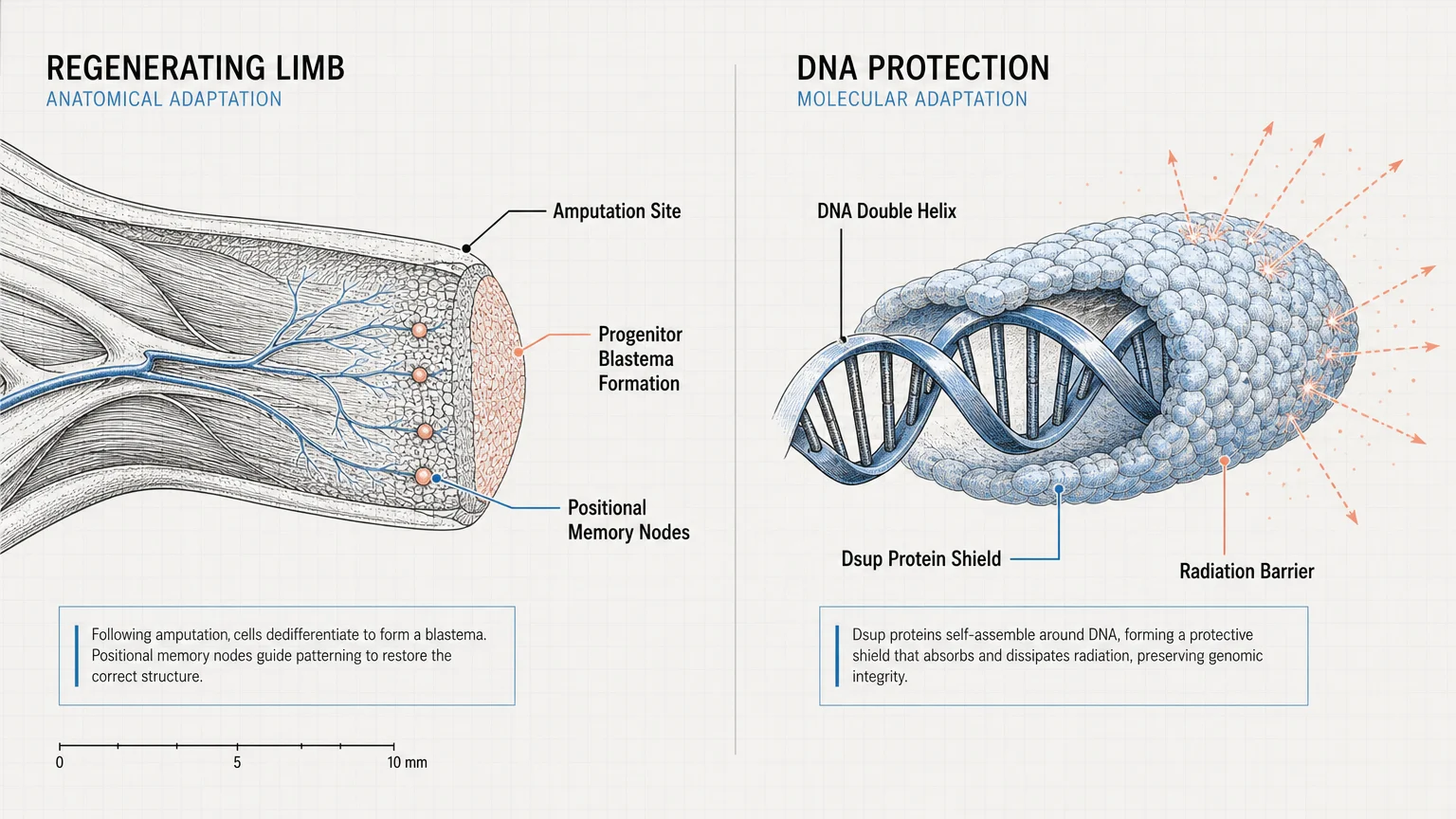
When you suffer severe physical trauma, your body prioritizes rapid healing over perfect restoration; this survival mechanism ultimately results in stiff, fibrotic scar tissue. The Mexican axolotl takes an entirely different evolutionary path. If an axolotl loses a limb to a predator, it does not form a scar. Instead, it develops a specialized mass of progenitor cells called a blastema. Over a few weeks, this blastema perfectly regenerates the missing limb, integrating intricate nerve networks, functional muscle fibers, and precise bone structures. The marvel of this regrowth relies heavily on positional memory. A landmark study exploring axolotl limb regeneration demonstrates that cells neighboring the amputation site retain a deep molecular awareness of their exact geographical location. They know instinctively whether they need to rebuild a complex shoulder joint or a delicate toe.
Microscopic tardigrades, affectionately known as water bears, represent some of the most resilient organisms on the planet. They routinely survive boiling water, absolute zero temperatures, severe dehydration, and the harsh vacuum of space. Their most profound superpower is their capacity to withstand radiation doses hundreds of times higher than the lethal limit for human beings. This invulnerability stems from a unique damage suppressor protein called Dsup. The Dsup protein wraps around the tardigrade’s DNA like a molecular shield, physically preventing radiation from shattering the delicate genetic strands. When researchers introduce this protein into cultured human cells, those cells gain remarkable resistance to X-ray damage.
If you were to remain completely motionless in a hospital bed for six months, you would suffer significant muscle atrophy, dangerous bone density loss, and a high risk of developing deep vein thrombosis. Hibernating brown bears perform this exact feat of inactivity every winter, yet they emerge in the spring perfectly healthy. A multinational team of scientists spent more than a decade decoding this physiological miracle. They discovered that during hibernation, the bear’s body drastically suppresses a specific protein responsible for driving blood coagulation and inflammation. Downregulating this protein makes the bear’s blood platelets significantly less sticky, completely preventing the formation of fatal blood clots even as the animal’s heart rate drops to mere beats per minute.

The Global Impact: Reshaping Human Health and Society
The implications of these wildlife discoveries extend far beyond academic curiosity; they possess the potential to reshape global public health and alter how healthcare systems operate. Consider the everyday realities of oncology wards around the world. Radiation therapy destroys aggressive tumors effectively, but it also inflicts severe collateral damage on surrounding healthy tissue. This reality leaves patients enduring painful inflammation, compromised immune systems, and chronic organ damage. If biomedical engineers can safely adapt the tardigrade’s DNA-shielding Dsup protein for clinical applications, doctors could administer targeted radioprotectants to your healthy cells before treatment begins. This innovation would allow oncologists to utilize higher, more effective doses of radiation to eradicate cancer while dramatically reducing the grueling side effects that patients experience.
Beyond the direct treatment of patients, animal adaptations are inspiring technological leaps in global pharmaceutical logistics. One of the greatest hurdles in delivering modern healthcare is the cold chain—the expensive, energy-intensive network of specialized refrigerators required to transport vaccines and biological medicines to developing nations. Because tardigrades utilize unique proteins to survive complete cellular desiccation, bioengineers now use these identical molecular structures to stabilize delicate therapeutic compounds. In the near future, laboratories might dehydrate life-saving vaccines, ship them globally at room temperature, and instantly rehydrate them at a rural clinic without sacrificing their medical efficacy.
Meanwhile, the lessons extracted from hibernating bears capture the urgent attention of cardiovascular surgeons and aerospace engineers alike. Blood clots remain a leading cause of preventable hospital deaths across the globe. Current anticoagulant medications perform well, but they carry significant risks of uncontrolled bleeding if a patient sustains a minor injury. A medication inspired by the bear’s targeted, seasonal blood-thinning mechanism offers a safer alternative. Physicians could reliably prevent deep vein thrombosis in bedridden individuals, patients recovering from major orthopedic surgery, and healthy travelers embarking on long-haul flights. Space agencies study this very same biological strategy to protect astronauts. As humanity sets its sights on crewed missions to Mars, astronauts face months of zero-gravity inactivity. Inducing a bear-like state of localized metabolic suppression could prevent the catastrophic bone density loss and cardiovascular deterioration that threaten deep-space exploration.
Voices from the Frontier: What the Experts Say
Translating the biological eccentricities of wild animals into viable medical therapeutics requires intense collaboration across molecular biology, ecology, and clinical medicine. The scientists spearheading these initiatives operate at the absolute edge of biological possibility, working tirelessly to isolate the precise chemical signals that grant animals their resilience.
When discussing the discovery of high-molecular-mass hyaluronan in the naked mole rat, biologist Andrei Seluanov from the University of Rochester highlights the serendipitous nature of scientific breakthroughs. His research team initially noticed that a uniquely gooey substance constantly clogged the vacuum pumps and tubing in their laboratory cell cultures. Seluanov explained that they needed to understand the exact composition of the goo, leading to the groundbreaking realization that this extreme viscosity serves as the physical barrier stopping cancer cells from multiplying. Dr. Vera Gorbunova, a leading authority on mammalian longevity, further confirmed that experimentally removing this compound made naked mole rat cells highly susceptible to tumors, perfectly illustrating the substance’s protective power.
In the rapidly advancing realm of regenerative medicine, Dr. Elly Tanaka of the Institute of Molecular Biotechnology dedicates her career to demystifying the axolotl’s regrowth capabilities. She emphasizes that the axolotl provides an unparalleled biological model for understanding how vertebrate tissue rebuilds itself from scratch. By mapping the cellular mechanisms of positional memory within regenerating tissue, Tanaka hopes to identify the precise biological instructions needed to program human cells. Her goal is to coax human biology into constructing a flawless limb rather than settling for a chaotic web of scar tissue.
Cardiologist Professor Ole Frøbert routinely ventures into freezing forests to draw blood from hibernating Scandinavian brown bears, driven entirely by the clinical potential of their physiology. Frøbert states that the identified hibernation protein is the crucial key to a natural mechanism that protects the body against blood clots during profound immobility. He notes that bypassing the traditional reliance on laboratory mice to directly study wild animals yields authentic insights into natural survival mechanisms. For Frøbert and his international colleagues, nature runs the most successful clinical trials imaginable; humanity simply needs to learn how to read the resulting biological data.
Frequently Asked Questions About Biomimicry and Medicine
Will you eventually receive animal genes to cure your diseases?
While the idea of injecting axolotl or tardigrade DNA directly into your bloodstream sounds like the plot of a science fiction film, the clinical reality proves far more sophisticated. Scientists do not attempt to create human-animal hybrids. Instead, they leverage the genetic blueprints of these animals to identify novel biological targets. Once researchers understand exactly how an animal protein functions, they develop small-molecule synthetic drugs or targeted therapies that temporarily mimic this beneficial mechanism in your own body. This approach provides the therapeutic effect safely without permanently altering your human genome.
How long does it take for wildlife discoveries to reach local pharmacies?
The journey from an ecological observation in the wild to an approved medical treatment remains notoriously slow, often spanning several decades. After scientists isolate a unique animal adaptation, they must successfully replicate the mechanism in human cell cultures within a controlled laboratory environment. If those initial tests show promise, the research progresses into mammalian models to rigorously verify safety and systemic compatibility. Only after clearing these demanding preclinical hurdles can the compound enter multi-phase human clinical trials. This timeline requires immense patience, but it ensures that resulting therapies remain strictly safe and highly effective for public use.
Are wild animals harmed to extract these medical secrets?
Ethical oversight serves as a foundational pillar of modern biological research, and strict regulatory protocols protect the animals involved in these studies. The vast majority of biomimicry research remains strictly observational or utilizes self-sustaining cell lines cultivated in petri dishes. For example, much of the research on naked mole rats relies on harmlessly obtained skin cells that grow indefinitely in a laboratory, leaving the living underground colonies completely undisturbed. When researchers study wild animals like hibernating bears, veterinary experts gently sedate the subjects in their natural habitats, take minimal blood samples, and safely return them to their winter dens without causing harm.
Why do animals possess these healing abilities while humans do not?
Evolution acts as a strict biological accountant, prioritizing traits based on an organism’s specific environmental pressures and daily survival needs. Human evolution heavily favored complex brain development, bipedal endurance hunting, and intricate social cooperation. Conversely, naked mole rats adapted to survive in highly crowded, oxygen-deprived subterranean tunnels, necessitating an extreme resistance to cellular damage. Your body still harbors many of the ancestral genetic building blocks required for complex regeneration and metabolic suspension; however, the precise genetic switches that activate these remarkable abilities simply turned off during millions of years of mammalian evolution.
A Forward Look: The Next Phase of Biomolecular Medicine
As our understanding of genomics and molecular biology deepens, the boundary between the natural world and the clinical laboratory will continually blur. The next decade promises a massive surge of translational research, moving these animal-inspired therapies out of the petri dish and directly into the hands of specialized physicians. Ongoing advances in tardigrade protein research already pave the way for preliminary safety models, allowing researchers to explore how synthetic damage suppressors might formulate into targeted delivery systems for patients actively undergoing radiotherapy.
Similarly, the groundbreaking work on positional memory in axolotls seamlessly merges with rapid advancements in precision gene-editing technologies. Researchers actively investigate whether temporary molecular modifications can trick human stem cells into behaving exactly like axolotl blastema cells. If these techniques succeed, early clinical applications might focus heavily on regenerating damaged heart tissue after a severe myocardial infarction or repairing severed spinal cords, effectively reversing catastrophic injuries currently considered permanent by modern medical standards.
While much remains unknown about the complex interplay of these genetic mechanisms, the prevailing optimism within the global scientific community feels palpable. You are witnessing a profound shift in how modern medicine tackles human fragility. Instead of merely synthesizing chemical compounds from scratch, scientists acknowledge that nature has already solved some of our most devastating health crises over millions of years of evolution. The definitive cures for cancer, paralysis, and cardiovascular disease may not just wait inside a sterile test tube; they swim freely in Mexican lakes, tunnel diligently beneath the African savanna, and sleep soundly in the snowy forests of Scandinavia. By continuing to study these remarkable animal superpowers, humanity moves one crucial step closer to unlocking a future defined by unprecedented medical resilience.