Waking from a vivid dream can leave you wondering why the scene looked completely drained of color. Whether you dream in black and white or bright hues depends less on your eyes than on how your sleeping brain builds memory.
Research shows that nearly half of dreams appear in color, while a smaller share unfold in stark grayscale. Your age, childhood media exposure, and the exact moment you wake up all shape the palette you remember each morning.
Understanding why we dream in distinct palettes reveals how sleep cycles, emotional networks, and visual cortex regions work together every night—and gives you practical ways to improve both dream recall and overall sleep quality.

The Real Prevalence of Color and Grayscale Dreams
If you rarely notice hues after waking, you share an experience common across modern sleep surveys. A 2017 study cited by The Washington Post in October 2024 examined how often everyday sleepers perceive color overnight.
Participants reported seeing color in nearly 50 percent of their dreams and black-and-white imagery in only 10 percent. In the remaining 40 percent of dreams, sleepers simply could not recall whether color had been present at all.
Separate population estimates suggest that roughly 12 percent of people report dreaming entirely in black and white. That gap highlights a crucial truth about sleep and dreams: missing a color in memory differs sharply from never seeing it during sleep.
People often assume dreams mirror waking vision like a high-definition movie playing behind closed eyelids. Yet your sleeping mind constructs imagery selectively, highlighting elements tied to emotion or action while leaving background details indistinct.
When you try to describe a dream over morning coffee, you reconstruct fragments rather than replaying a complete recording. If a scene carried strong tension or movement, your recall may lock onto shapes and motion instead of subtle shades.
Mixed Palettes and the Dominance of Bold Hues
Dream palettes rarely follow strict all-or-nothing rules across an entire night. A 2008 study by Eva Murzyn in Consciousness and Cognition found that 10 to 20 percent of participants experienced mixed dreams containing both color and grayscale elements.
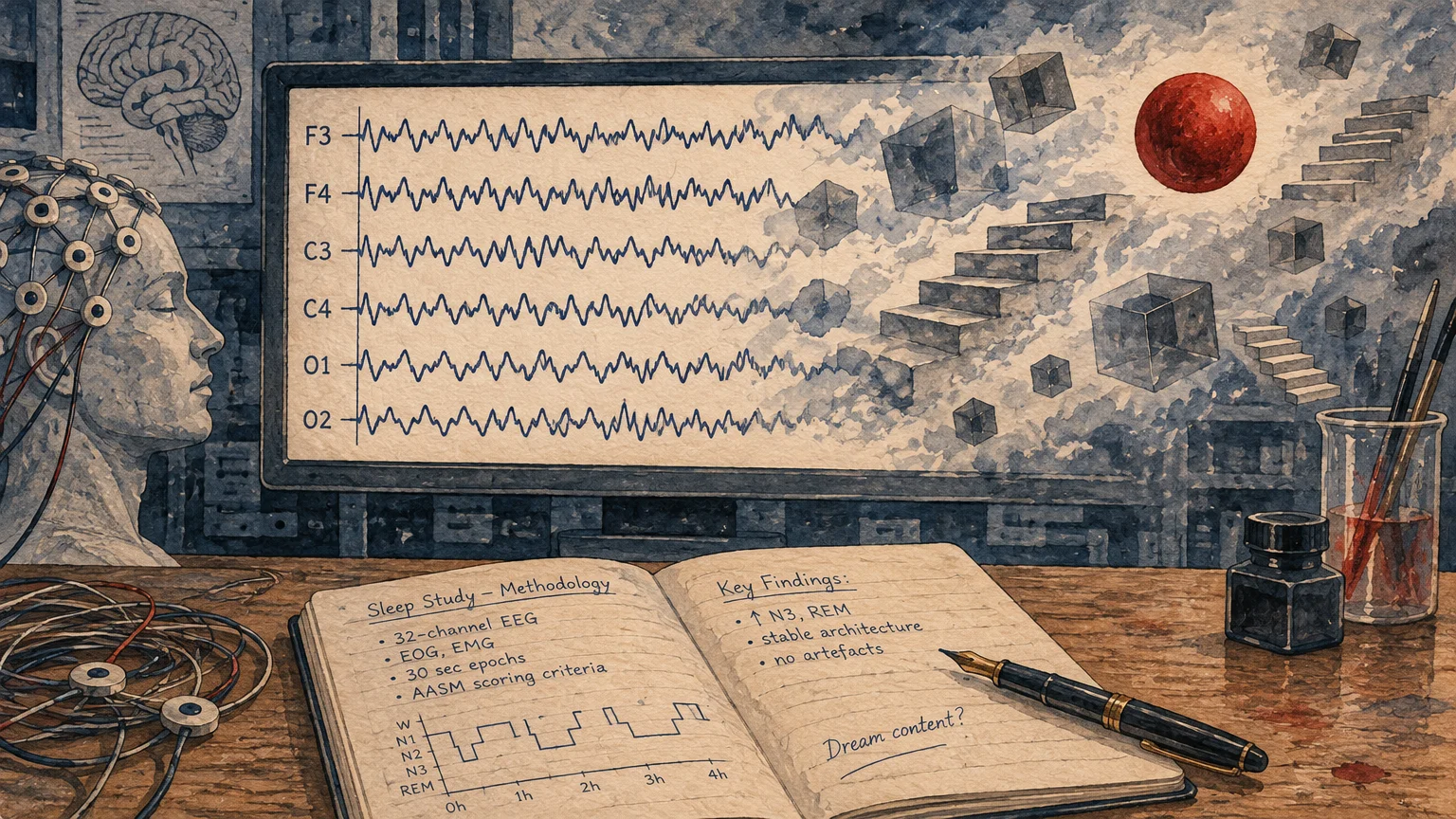
You might recall a vividly crimson object standing out against a washed-out, colorless street or hallway. Those selective highlights reflect how attention and emotional salience operate when external light is absent.
Data from the Sleep and Dream Database, which holds more than 40,000 dream entries, reinforces this pattern of selective visual focus. Database founder Kelly Bulkeley notes that the most frequently reported dream colors are black, white, and red.
High-contrast shades and bold primary tones register easily in waking language when you narrate an unusual experience. Subtle pastels or muted backgrounds require far more deliberate attention to survive the transition from sleep to wakefulness.
Recognizing this selective focus helps you interpret your own dream journal without worrying about missing details. A muted or monochromatic scene usually points to how your memory filtered the dream rather than any flaw in your visual system.
How Study Methods Change the Science of Dreams
For decades, scientists puzzled over why surveys produced wildly different numbers regarding dreaming in color. The mystery began to clear once researchers examined how and when they asked sleepers to describe their dreams.
Asking someone about last night’s dream hours after breakfast relies entirely on fragile morning memory. Waking people directly out of active dreaming inside a sleep laboratory captures visual details before those impressions fade.
Spontaneous Morning Recall Versus Lab Awakenings
In a 2008 review of seven studies, dream researcher Michael Schredl found that spontaneous dream reports mention color only 11 to 46 percent of the time. For instance, Calvin Hall’s 1951 analysis of 3,000 reports recorded color in just 29 percent.
A similar 1962 analysis by Kahn and colleagues found spontaneous color mentions in only 25 percent of reports. Under casual morning questioning, grayscale or uncolored impressions appear to dominate human dreaming.
Everything changes when researchers wake volunteers directly from Rapid Eye Movement (REM) sleep and ask specifically about color. Across classic laboratory trials, immediate color recall jumps dramatically to between 69 and 83 percent.
In 1962, Kahn, Dement, Fisher, and Barmack discovered that 83 percent of dreams collected immediately after REM awakening contained color. Six years later, Herman, Roffwarg, and Tauber reported that 69 percent of REM awakenings yielded clear color descriptions.
Schredl and colleagues pushed this method further in 2008 by asking sleepers immediately upon waking to log the color of every dream element. Under that targeted protocol, 100 percent of dream reports contained at least some color.
That striking jump from 25 percent to 100 percent proves how strongly your reporting method shapes what you think you saw. When you do not consciously look for color right as you wake, your brain drops chromatic labels first.
The Forgetting Problem Behind Grayscale Memories
Memory decay explains why so many sleepers believe they regularly dream in black and white. Schredl and colleagues observed in 2008 that participants who reported more black-and-white dreams also recalled fewer dreams overall and remembered them in less detail.
When researchers updated study questionnaires to include an option stating that respondents might simply have forgotten the color, reports of black-and-white dreams dropped significantly. People often mistake an unrecorded visual detail for an absence of color.
Think of how you remember a hurried conversation from several days ago. You retain the core message and who spoke, yet you rarely remember the exact shade of the person’s shirt unless it mattered to the story.
Dreams operate under similar memory constraints, except your brain clears fragile short-term traces even faster upon waking. Keeping a small notebook beside your bed lets you test this forgetting effect firsthand within seconds of opening your eyes.

Television, Culture, and Generational Shifts in Dreaming
Memory bias explains part of the story, yet cultural history adds an equally fascinating layer to the science of dreams. Over the past century, reports of dreaming in color surged alongside a major shift in visual technology.
Before color television and cinema filled living rooms, the majority of surveyed adults insisted their dreams were colorless. Tracking those generational changes shows how everyday visual media can subtly train the way you perceive and recall inner imagery.
From Mid-Century Black-and-White Screens to Modern Color
In 1942, Warren C. Middleton surveyed 277 U.S. college sophomores about the visual palette of their nighttime thoughts. An overwhelming 70.7 percent reported rarely or never seeing colors in their dreams—31 percent said rarely and 40 percent said never.
Only 10 percent of Middleton’s students reported seeing dream colors frequently or very frequently. Similarly, a 1958 study by Tapia, Werboff, and Winokur found that roughly 9 percent of non-psychiatric hospital patients reported colored dreams.
More than half a century later, those numbers flipped almost completely in the opposite direction. In 2001, Eric Schwitzgebel replicated Middleton’s 1942 questionnaire with 124 college students and published the findings in Perceptual and Motor Skills in 2003.
Only 17.7 percent of Schwitzgebel’s students reported rarely or never seeing colors in their dreams. Within sixty years, reports of routine grayscale dreaming had fallen by more than fifty percentage points among young adults.
Researchers tested whether screen technology—rather than shifting survey habits—drove that dramatic transformation. In a 2006 study published in Dreaming, Schwitzgebel, Huang, and Zhou compared populations across different regions of China with unequal access to color media.
Among low-status rural Chinese respondents—where only 19 percent saw color film or television before age 11—just 29 percent dreamed in color occasionally. Among intermediate-status urban respondents with 47 percent early color media access, 39 percent dreamed in color.
Those cross-cultural comparisons suggest that early exposure to grayscale screens leaves a lasting imprint on how people remember—or visually frame—their dreams. Media does not change human biology, yet it shapes the visual templates your mind draws upon.
Why Age and Media Access Matter
A 2008 study led by Eva Murzyn at the University of Dundee examined how childhood television exposure interacted with aging in the United Kingdom. Adults older than 55 reported dreaming in color about 34 percent of the time.
By contrast, adults younger than 25 reported dreaming in color roughly 68 percent of the time. Meanwhile, 18 percent of older adults and 15 percent of younger adults said they did not remember dream colors at all.
Looking specifically at childhood viewing habits revealed an even clearer link to past screen technology. Twenty-five percent of older respondents exposed only to black-and-white television in childhood dreamed in black and white, compared with 7 percent raised with color television.
Still, media exposure alone cannot explain every shift across the human lifespan. Two surveys conducted 16 years apart and published in 2011—later cited by The Washington Post in 2024—revealed a steady age-related decline in color recall.
Roughly 80 percent of participants under age 30 reported color in their dreams, dropping to about 20 percent by age 60. At the same time, color dreaming increased between 1993 and 2009 among adults in their twenties, thirties, and forties.
Notice how both cohort effects and normal aging shape these patterns simultaneously. Growing up with rich color screens primes lifelong expectations, while age-related changes in sleep depth and morning memory recall may soften vivid color retention later in life.
Inside the Brain: How Neural Circuits Paint Your Dreams
To understand why we dream in vivid color or muted gray, you need to look at how sleep architecture unfolds overnight. Your brain cycles through distinct biological states that govern both emotional intensity and visual clarity.
Far from powering down at bedtime, neural networks reorganize how sensory signals travel across cortical regions. That internal choreography explains why dream imagery feels immersive even though your eyelids stay shut in a dark room.
Sleep Architecture and the Timing of Vivid REM
According to the National Heart, Lung, and Blood Institute and the National Sleep Foundation, a typical sleep cycle repeats roughly every 80 to 100 minutes. Across a full night, adults usually complete four to six of these 90-minute cycles.
REM sleep—the stage most strongly linked to complex, story-driven dreaming—accounts for roughly 25 percent of total adult sleep time. Normal healthy ranges span 15 to 30 percent in adults, down from about 50 percent during infancy.
Early in the night, deep slow-wave sleep dominates each cycle while REM episodes stay brief. Toward morning, REM periods lengthen considerably, giving your brain extended stretches to weave detailed visual narratives.
Over a healthy night, adults average four to seven dreams lasting from a few minutes up to roughly 30 minutes each. Those episodes add up to one to two hours of active dreaming before your alarm rings.
Because your longest REM periods cluster right before dawn, cutting sleep short by even an hour removes prime dreaming time. Waking naturally from a late-morning REM cycle often leaves you with brighter, sharper visual memories than jarring early alarms.
Visual Cortex Regions Without External Light
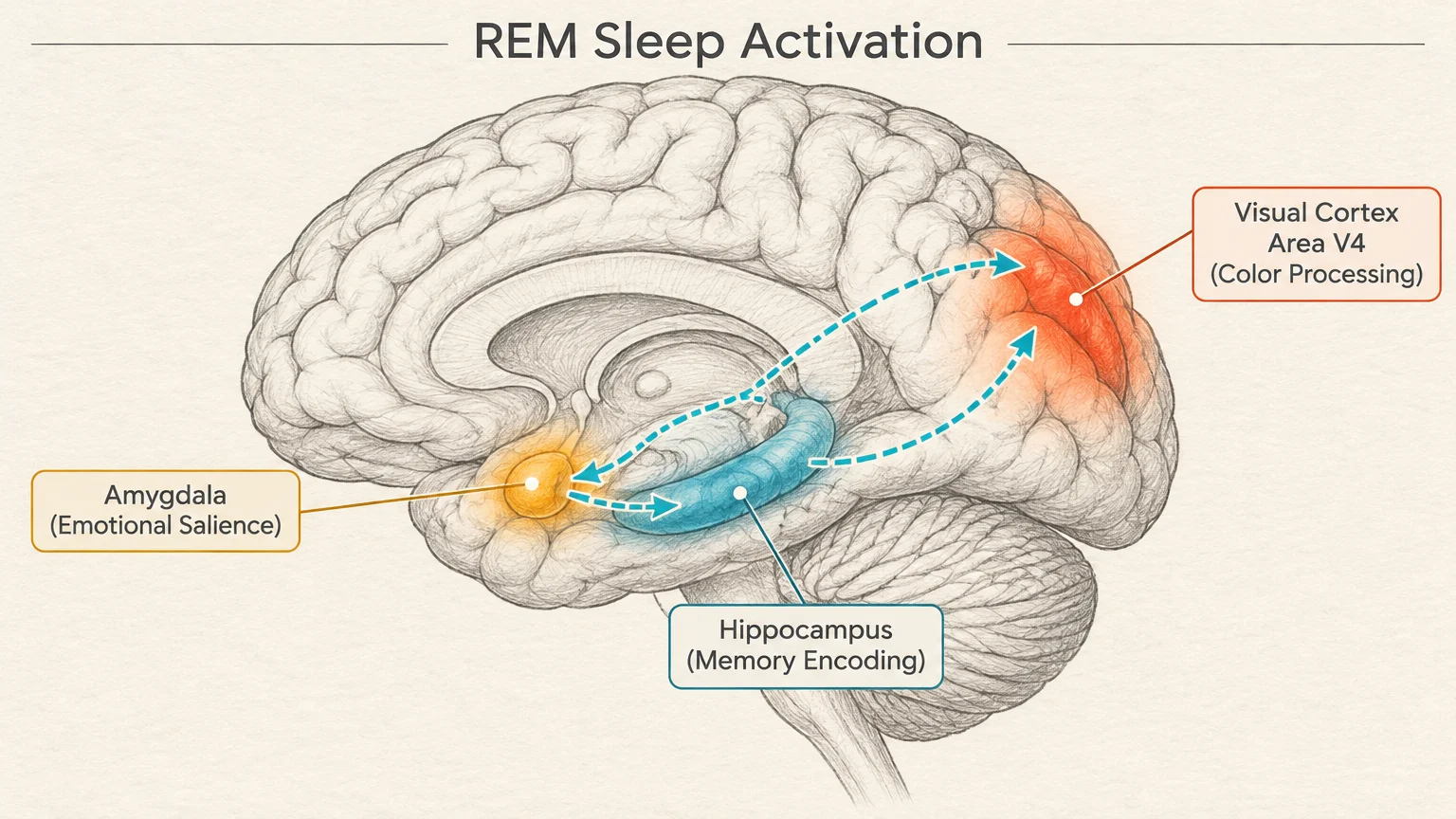
Guidance from the National Institute of Neurological Disorders and Stroke maps the neural relays driving this nocturnal cinema. During REM sleep, the thalamus sends internal images, sounds, and sensations directly to the cerebral cortex.
Simultaneously, the amygdala—your brain’s emotional processing hub—becomes highly active, infusing dream scenes with fear, wonder, or urgency. Meanwhile, the brainstem, specifically the pons and medulla, blocks signals to skeletal muscles so you do not act out dreams physically.
How does the cortex manufacture color without daylight hitting your retinas? Functional neuroimaging research by Steven Shevell and colleagues at the University of Chicago, published in PNAS in 2020, clarifies where subjective color arises.
Their findings show that subjective color experience is encoded in higher visual cortex areas—notably the V4 region and fusiform gyrus—rather than solely in the primary visual cortex. During sleep, internal signals can stimulate those specialized color hubs directly.
Research by Hobson and Friston in 2012 demonstrates that visual and emotional networks fire robustly during REM while the prefrontal cortex largely deactivates. Because the prefrontal cortex governs waking logic and reality testing, you accept surreal hues or missing colors unquestioningly.
If internal signals robustly engage V4 and the fusiform gyrus alongside emotional networks, your dream blooms with color. If your brain prioritizes spatial motion or narrative tension while bypassing color-encoding hubs, the memory settles into monochrome.
Practical Impact: Using Dream Science to Support Sleep Health
Knowing how sleep and dreams operate offers more than dinner-table trivia; it points directly to daily habits that protect brain health. Dream recall and color vividness often act as gentle barometers of whether you are reaching restorative late-night REM stages.
When chronic stress, irregular schedules, or insufficient rest compress your sleep cycles, emotional processing and memory consolidation both suffer. Prioritizing consistent rest restores the architecture your mind needs for healthy dreaming and daytime clarity.
Actionable Habits for Better Sleep and Dream Recall
The American Academy of Sleep Medicine and the Sleep Research Society issued a consensus statement in 2015 recommending that adults aged 18 to 60 sleep seven or more hours nightly. Following that baseline gives late-night REM cycles room to expand.
In June 2026, the National Sleep Foundation published a 10-year review of 133 meta-analyses in Sleep Health reaffirming seven to nine hours for adults. For adults 65 and older, CDC guidance lists seven to eight hours nightly.
Despite clear evidence, sleep deprivation remains widespread across modern life. Data from the Centers for Disease Control and Prevention in Data Brief 559 shows 30.5 percent of U.S. adults averaged under seven hours of sleep in 2024.
If you want to remember more dream detail—including whether scenes appear in color—start by protecting your final 90-minute sleep cycle. Going to bed 30 to 45 minutes earlier helps preserve morning REM periods rather than truncating them.
Next, pause quietly for sixty seconds after waking before checking your phone or jumping out of bed. Moving slowly keeps delicate short-term visual memories intact long enough for your waking cortex to label colors and objects.
Keep a pen and small notebook on your nightstand and jot down three sensory cues right away. Recording even brief fragments—a red coat, a dim hallway, a sudden sound—trains your waking attention to notice chromatic details over time.
Maintain a steady wake time across weekdays and weekends to anchor your circadian rhythm. Regular timing stabilizes when REM sleep occurs, making dream episodes more predictable and daytime energy steadier.
Sleep Equity, Environment, and Mental Wellbeing
Sleep quality does not depend solely on personal willpower; social, economic, and environmental conditions heavily influence who reaches restorative REM sleep. Shift work, noisy neighborhoods, unsafe housing, and caregiving demands disproportionately fragment rest for lower-income households and marginalized communities.
Excessive artificial light at night and hot sleeping spaces also disrupt sleep architecture, cutting into deep and REM stages alike. Simple low-cost adjustments—such as blackout curtains, ear protection, or cooling airflow—can noticeably strengthen overnight recovery.
Mental wellbeing also shapes your nocturnal visual world through heightened amygdala activity during periods of stress or trauma. While emotional intensity can heighten striking colors like red, chronic exhaustion can leave dreams fragmented and hard to recall.
Treating sleep as an essential pillar of preventive medicine encourages clinicians and communities to address environmental barriers alongside individual habits. Better rest improves emotional regulation, metabolic health, and cognitive resilience far beyond what happens in your dreams.
Caveats and Next Steps in Sleep and Dream Research
Even with advanced brain imaging and decades of sleep lab trials, dream science still faces real methodological limits. Researchers cannot yet observe a dream’s visual palette directly on a screen as a person sleeps.
Nearly every finding depends on retrospective self-reporting once a sleeper wakes up. Because waking memory alters fragile impressions within seconds, researchers cannot fully separate what a dreamer saw during REM from what they reconstructed afterward.
Historical comparisons across generations also carry built-in limitations because survey wording and cultural expectations change over time. Someone raised with color media expects colorful dreams and notices hues more readily than someone from an earlier era.
Furthermore, most media-exposure studies look at snapshots across different age groups rather than following the exact same people from childhood into old age. Long-term longitudinal research is still needed to separate aging effects from cultural shifts.
Ongoing neuroimaging investigations are now mapping how V4, the fusiform gyrus, and emotional networks interact across different sleep stages. Future tools may clarify whether monochromatic dreams stem purely from retrieval gaps or genuine differences in cortical activation.
Frequently Asked Questions About Dream Color and Sleep
Does dreaming in black and white indicate a vision or brain problem?
No; dreaming in black and white is a normal variation in human sleep and dream recall. Roughly 12 percent of people report dreaming exclusively in grayscale, and healthy sleepers frequently forget dream colors by morning.
Your eyes do not generate dream imagery, and color-encoding cortex regions remain fully capable during waking hours even if your dreams seem muted. Only sudden changes in waking vision—not grayscale dreams—warrant an eye examination.
Can you train yourself to start dreaming in color?
You cannot force your sleeping brain to paint every scene in vivid tones, yet you can dramatically improve color recall. Laboratory studies show that asking sleepers to notice colors immediately upon waking pushes color detection close to 100 percent.
Keeping a bedside journal and listing specific shades as soon as you open your eyes trains your memory before details evaporate. Protecting seven to nine hours of sleep also extends morning REM cycles when vivid imagery peaks.
Why do I remember fewer colors when I feel stressed or sleep-deprived?
Sleep deprivation and high stress often fragment sleep cycles and shorten late-morning REM periods. When your alarm interrupts rest early or you wake abruptly, fragile sensory details vanish before your waking cortex can record them.
Stress can also narrow attention toward urgent emotional threats rather than background aesthetics during sleep. Restoring a consistent bedtime routine and calming pre-sleep wind-down often brings sharper, fuller dream memories back naturally.
When should you speak with a doctor about changes in your sleep and dreams?
Reach out to a clinician if vivid or distressing dreams repeatedly wake you up, leave you exhausted during the day, or disrupt daily functioning. Acting out dreams physically—such as punching or kicking during sleep—also deserves prompt medical evaluation.
During healthy REM sleep, your brainstem inhibits muscle movement to keep you safely still. When that protective paralysis falters, a sleep specialist can screen for underlying sleep disorders and protect your safety.

Working With Professionals to Protect Your Rest
Whether your nighttime stories unfold in bold technicolor or quiet monochrome, they reflect a healthy brain sorting memories and emotions behind closed eyelids. Paying attention to your dreams can offer helpful clues about your stress load and sleep duration.
Before making major changes to your sleep schedule, supplements, or mental health routine, consult a qualified physician, sleep specialist, or licensed therapist. Personalized medical guidance ensures your sleep habits support both your physical health and emotional wellbeing safely.