
You can now view the dramatic aftermath of humanity’s first planetary defense test. The European Space Agency has returned the first close-up images of asteroid Dimorphos, revealing a massive, stadium-sized crater carved across its surface.
When NASA slammed the DART spacecraft into the moonlet in 2022, scientists could only deduce the damage from telescopic readings. These sharp new photographs confirm that our kinetic strike permanently flattened an entire face of the celestial body.
Hera’s initial observations provide essential ground truth for protecting our planet from future asteroid hazards.
In This Briefing07 Sections ▾
A Stadium-Sized Scar in Deep Space
On November 25, 2026, mission officials unveiled the first detailed images of the impact site during a briefing in Berlin. Planetary scientists confirmed that the collision altered the asteroid’s landscape far more dramatically than initial ground observations suggested.
The primary image, captured on November 7 from 29 kilometers away at 2.7 meters per pixel, shows an excavation stretching across the moonlet. The kinetic strike flattened one complete face of the 151-meter-wide asteroid into a bowl-shaped depression.
Inside the impact basin, researchers identified unexpected geological formations. Most notably, an elongated, cigar-shaped mound rests near the center of the excavation zone.
You can see stark contrasts when comparing this crater with earlier reconnaissance from the NASA DART mission. Outside the impact zone, Dimorphos’s boulder fields remain largely intact and undisturbed.
The parent asteroid, the 730-meter-wide Didymos, also shows no structural changes from the event. The energy localized on Dimorphos, scarring one side while leaving the rest of the binary system physically stable.
Tumbling Motion and Orbiting Boulder Swarms
Before the kinetic impact, Dimorphos was tidally locked to Didymos, keeping one face permanently turned toward its primary. Hera’s flight instruments revealed that the collision broke this lock, sending the asteroid into a chaotic, wobbling tumble.
This irregular rotation complicates spacecraft operations in deep space. Flight engineers must calculate precise approach trajectories to compensate for the moonlet’s shifting orientation.
Hera also uncovered a swarm of loose debris orbiting within the binary pair. A composite image captured on November 6 revealed hundreds of meter-sized boulders drifting around the two asteroids.
Hubble Space Telescope observations in 2023 had detected only 37 ejected boulders. The newly discovered swarm of hundreds of rocks presents a real collision hazard for upcoming low-altitude passes.
Verifying the Kinetic Deflection Method
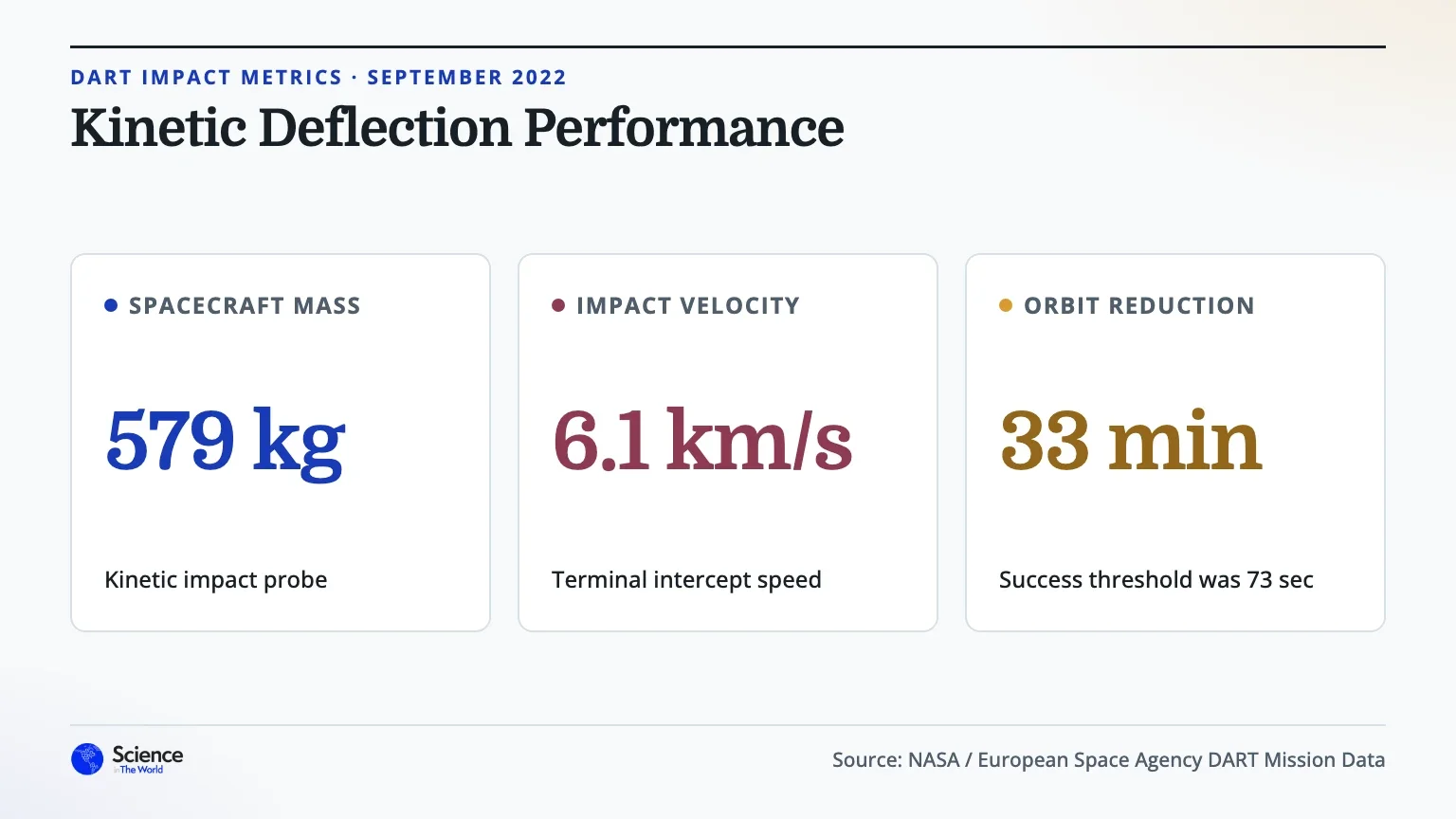
The 579-kilogram DART probe struck Dimorphos on September 26, 2022, traveling at roughly 6.1 kilometers per second. That impact shortened Dimorphos’s orbital period around Didymos by 33 minutes, far exceeding the 73-second success threshold.
A landmark Nature study on the kinetic impact estimated that escaping rock fragments provided significant momentum enhancement. Hera will now establish the exact momentum multiplier by measuring the total mass expelled from the crater.
These calculations directly improve planetary defense models on Earth. Knowing how much material an impact ejects helps engineers design kinetic spacecraft with the precise mass needed to divert future threats.
Without on-site verification, defense planners must rely on assumptions. Hera’s close-up observations turn theoretical deflection equations into dependable engineering blueprints.
The Technology Guiding Hera’s Investigation
Hera launched on a SpaceX Falcon 9 rocket on October 7, 2024, completing a fast transit aided by a Mars flyby. The spacecraft arrived at the asteroid system on November 4, 2026—a full month ahead of schedule.
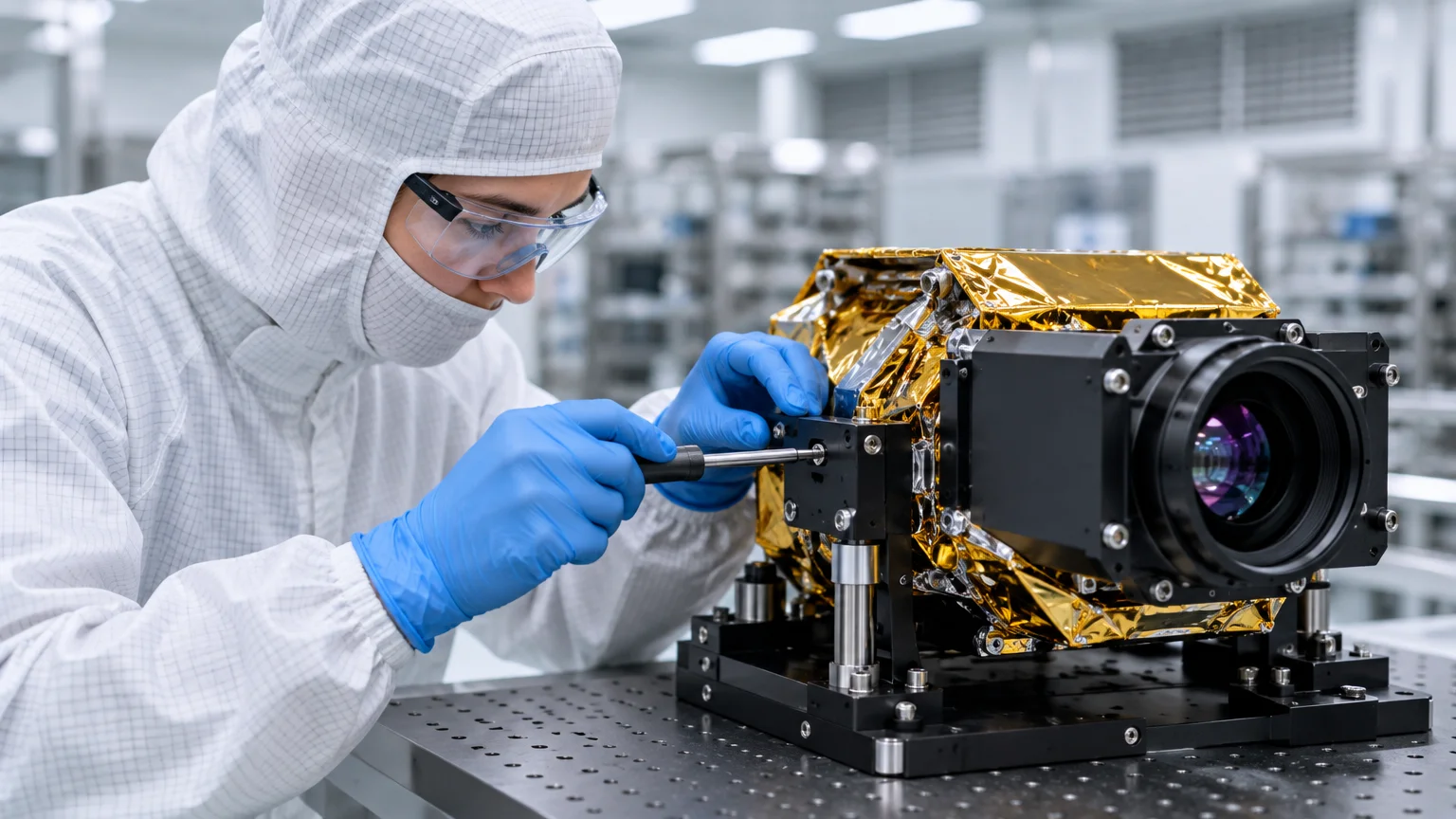
Operating roughly 193.5 million kilometers from Earth, Hera relies on three specialized imaging systems. The Asteroid Framing Camera maps physical terrain, while the HyperScout-H spectrometer tracks surface mineralogy.
The probe also carries a Thermal Infrared Imager developed by the Japan Aerospace Exploration Agency. This sensor measures thermal inertia, helping scientists determine whether Dimorphos is a consolidated rock or a fragile rubble pile.
Global Impact and Planetary Defense
Asteroid mitigation requires rapid international coordination across technical and geopolitical boundaries. An unmitigated impact from an asteroid the size of Dimorphos could flatten a metropolitan area, creating widespread humanitarian and economic crises.
The collaboration between NASA and European teams proves that cross-border space defense works. While American hardware proved we can strike a moving asteroid, European instruments are showing us the precise physical outcome.
You benefit directly from these shared initiatives. Standardized impact data allows the global community to prepare unified response protocols long before a hazardous object threatens Earth.
Frequently Asked Questions
Did the DART impact shatter Dimorphos into pieces?
No, the collision did not destroy the asteroid. DART excavated a stadium-sized crater across one face, but the rest of Dimorphos survived intact alongside Didymos.
Why did Dimorphos begin tumbling after the strike?
The off-center kinetic strike delivered massive rotational torque to the small moonlet. That sudden transfer of energy broke its tidal lock, causing it to wobble irregularly along its orbital path.
Do the newly discovered boulders threaten Hera?
Yes, the meter-sized boulders represent a navigational hazard. Mission controllers must map every orbiting fragment before sending Hera and its secondary probes closer to the asteroid’s surface.
When will scientists know the exact mass displaced by DART?
Researchers expect precise mass calculations between December 2026 and early 2027. Hera’s lower-altitude flybys will measure local gravity fields and calculate the crater’s exact volume.
The Next Phase of Exploration
In December 2026, Hera will maneuver within 13 kilometers of Dimorphos. This close approach will capture sharp, high-resolution views of the crater’s interior structure and the strange central mound.
In January 2027, the spacecraft plans to deploy two shoebox-sized CubeSats named Milani and Juventas. Milani will analyze mineral dust, while Juventas will use low-frequency radar to sound the asteroid’s interior.
Both CubeSats will attempt direct touchdowns on Dimorphos around June 2027. You can watch these milestones unfold as planetary defense moves from experimental trials to an operational safeguard.