You might think our human evolutionary tree is already complete, but four ancient teeth found in southern China tell a different story. These fossil teeth reveal that an unresolved archaic human group may have lived alongside Denisovans more than 100,000 years ago.
Researchers found these fossils inside two limestone caves across the Guangxi region. By studying proteins preserved inside the enamel, scientists uncovered crucial clues about ancient hominins in East Asia.
These surprising findings show that our ancestral past was far more crowded than experts once believed. Here is how this discovery changes what you know about the human story.
In This Briefing08 Sections ▾
- 01Unlocking Ancient Enamel in Guangxi Caves
- 02Two Caves Reveal Two Separate Lineages
- 03A Distinct Chemical and Physical Identity
- 04A Crowded Subtropical Landscape
- 05Voices from the Researchers
- 06How Ancient Protein Science Benefits You Today
- 07Frequently Asked Questions
- 08Looking Forward in Asian Prehistory
Unlocking Ancient Enamel in Guangxi Caves
In 2015, field teams launched a massive survey across a 500-kilometer migration corridor in southern China. Six years later, in 2021, they recovered four isolated hominin teeth from two karst caves in Guangxi.
The team found two teeth in Chuanshandong cave and two teeth in Longchuandong cave. However, extracting genetic material from these sites presented a severe challenge.
Subtropical heat and humidity quickly destroy ancient DNA. Because of this environmental decay, no usable ancient DNA survived inside the teeth.
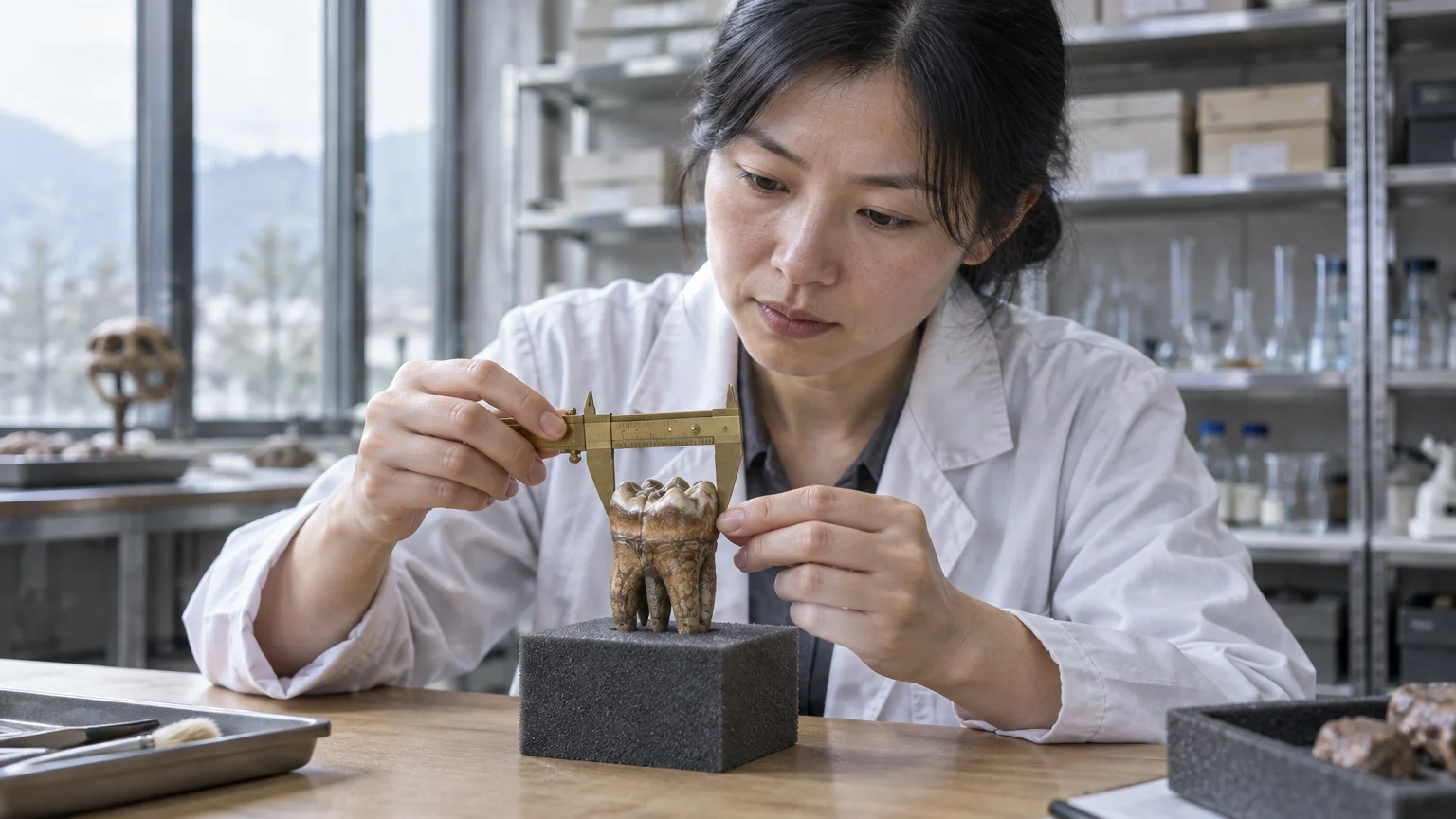
To bypass this obstacle, the scientists turned to paleoproteomics. This method extracts durable structural proteins trapped within fossilized tooth enamel.
Enamel is the hardest tissue in the human body. Its mineral structure protects protein chains long after delicate genetic strands break down.
Using this technique, researchers tested three of the four teeth. The analysis confirmed that all sampled teeth belonged to male individuals.
Two Caves Reveal Two Separate Lineages
The research team applied uranium-series dating directly to the fossil teeth. This dating method measures the radioactive decay of uranium isotopes inside the enamel.
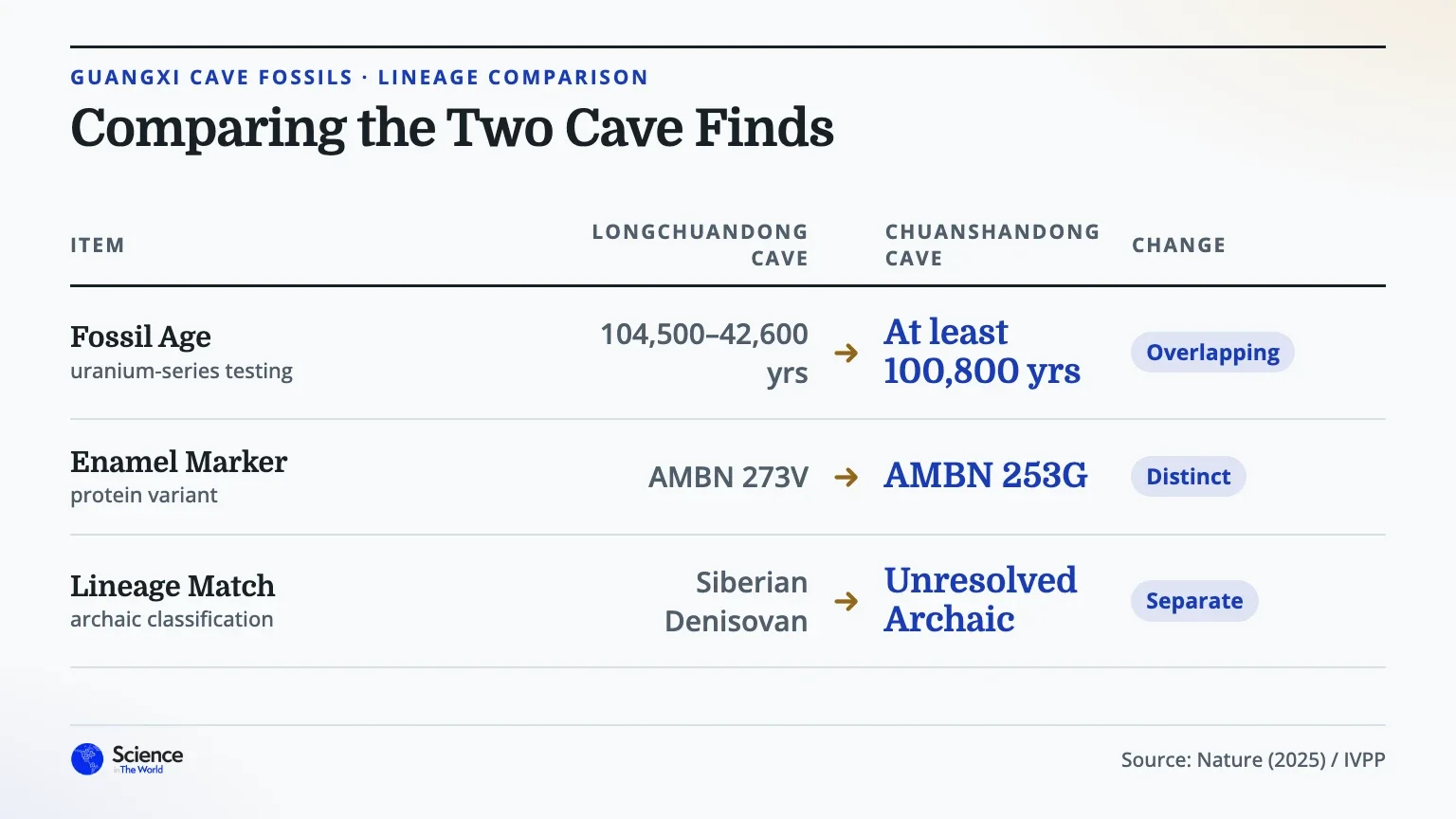
At Longchuandong cave, tests dated an upper molar and a lower premolar to between 104,500 and 42,600 years ago. Both teeth carried an enamel protein marker known as AMBN 273V.
This specific protein marker matched the Siberian Denisovan genome with 100 percent statistical support. Their physical shape also closely mirrored known Denisovan teeth from the Altai Mountains.
This result provides the first direct fossil evidence of Denisovans living in China’s subtropical Lingnan region. You can read the full study in Nature for detailed molecular breakdowns.
However, Chuanshandong cave yielded a completely different result. Scientists recovered a matching pair of lower bicuspids that likely belonged to a single individual.
Uranium-series testing showed that this individual lived at least 100,800 years ago. When researchers analyzed the enamel proteins, the Denisovan signature was entirely absent.
A Distinct Chemical and Physical Identity
Instead of matching Denisovans, the Chuanshandong tooth carried a rare protein variant known as AMBN 253G. Before this study, scientists had only seen this variant in late Homo erectus fossils.
Those earlier Homo erectus fossils came from northern and eastern Chinese sites dating back roughly 400,000 years. The tooth also contained AMELY 179M, an ancestral variant shared with great apes.
Physical scans revealed an intriguing mix of anatomical features. The premolars displayed complex, ancestral roots alongside modern, symmetrical crowns.
When researchers built a family tree using this protein profile, the specimen occupied an unexpected position. It formed a sister group to the common ancestor of modern humans, Neanderthals, and Denisovans.
This branch received 100 percent statistical support in the team’s phylogenetic model. Yet the researchers did not declare a new species.
Instead, they classified the find as an unresolved archaic Homo lineage. This cautious label reflects the need for more physical evidence before drawing final conclusions.

A Crowded Subtropical Landscape
These overlapping dates suggest that two distinct human populations inhabited the same regional landscape during the Middle-to-Late Pleistocene. They shared lush valleys alongside ancient elephants and tapirs.
For years, many anthropologists wondered if Denisovans were the sole archaic humans across late prehistoric Asia. Recent genetic work supported that unifying view.
In 2025, researchers connected the famous Harbin skull to Denisovans through ancient proteins reported in Science. Additional discoveries at Bianfu Cave in Yunnan also reinforced their wide geographic presence.
Those Bianfu Cave excavations yielded seven Denisovan fossils alongside thousands of stone tools. A related report in Nature further linked northern China’s Xujiayao remains to Denisovans.
The Chuanshandong teeth now show that this picture was incomplete. While Denisovans certainly roamed southern China, an unresolved and older archaic group apparently lived nearby.
Voices from the Researchers
The research effort brought together scientists from the Institute of Vertebrate Paleontology and Paleoanthropology in Beijing. Senior authors Song Xing and Qiaomei Fu highlighted both the power and limits of their data.
Fu pointed out that ancient proteins survive far longer than ancient DNA in warm climates. Without paleoproteomics, these damaged teeth would have remained unclassified.
At the same time, the research team highlighted several critical caveats. The Chuanshandong classification relies on proteins extracted from just one tooth.
That identification depends on only two amino acid positions in the protein chain. Furthermore, paleontologists have not found any stone tools or skull bones in either cave.
Because scientists lack other Denisovan bicuspids for direct comparison, they must interpret physical tooth traits carefully. More excavations will help confirm how these archaic groups interacted.
How Ancient Protein Science Benefits You Today
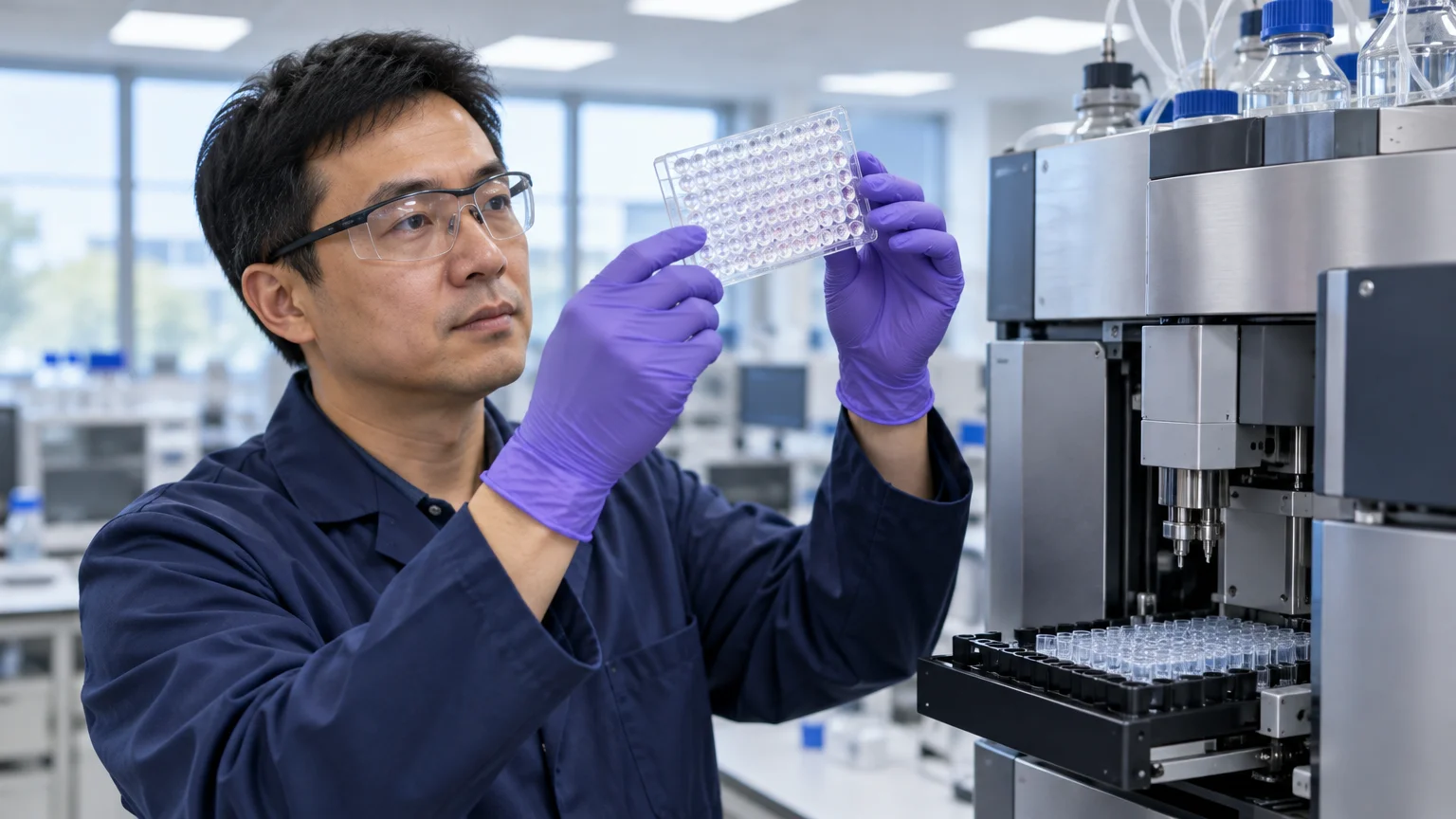
Studying fossil teeth might feel distant from modern daily life, but the underlying science offers practical benefits. Paleoproteomics directly drives modern breakthroughs in clinical medicine.
Medical researchers now use these sensitive protein-sequencing tools to detect early biomarkers for chronic diseases. The exact same methods help doctors identify subtle cellular changes in human tissue.
Forensic investigators also apply enamel proteomics to identify human remains in cold cases. Because enamel survives fires and chemical decay, it helps identify victims when DNA tests fail.
By learning how archaic humans adapted to past environments, geneticists also discover how ancient genes protect modern bodies. These ancient survival traits still shape human immunity today.
Frequently Asked Questions
Did this unresolved lineage interbreed with modern humans?
Scientists do not yet have evidence showing interbreeding between this specific Chuanshandong lineage and modern humans. Because researchers only recovered teeth without DNA, confirming gene flow requires future fossil discoveries.
Why could scientists not recover ancient DNA from the teeth?
Subtropical karst caves are warm and wet, which causes fragile DNA molecules to break down rapidly. Tooth enamel proteins are much harder, allowing them to survive intact for over 100,000 years.
Are these Chuanshandong teeth proof of a brand new human species?
No, the researchers explicitly refrained from naming a new species. The fossil evidence comes from a single individual, so experts classify it cautiously as an unresolved archaic Homo lineage.
How did the teeth end up deep inside the cave sediments?
Water and gravity likely washed the isolated teeth into deeper cave layers over thousands of years. Surrounding sediments dated younger than the teeth, showing that natural cave erosion shifted the fossils.
Looking Forward in Asian Prehistory
Paleontologists are currently planning new excavations across southern China’s extensive karst cave networks. They hope to locate associated stone tools, ancient hearths, and identifiable skull fragments.
Meanwhile, laboratory teams are refining mass spectrometry methods to extract even more amino acid sequences from tiny enamel samples. These refined tests could uncover additional molecular markers.
As field surveys expand into Southeast Asia, researchers expect to find more pieces of this complex puzzle. Your understanding of human origins will continue to evolve with every newly tested tooth.