Understanding the complex mechanics of your eyes unlocks crucial strategies for preserving your vision and maintaining your overall health. Your optic system works as a direct extension of your brain, capturing detailed environmental data and providing surprising clues about systemic diseases long before other symptoms appear. Despite their small size, these biological cameras consume vast amounts of energy and rely on intricate vascular networks to function properly. Recent breakthroughs in oculomics demonstrate that routine eye exams can now reveal early markers of cognitive decline and cardiovascular distress. When you learn how these remarkable organs operate, adapt to modern digital strain, and heal themselves, you gain actionable insights to protect your eyesight in an increasingly screen-dominated world.
A Discovery Deep Dive Into Your Visual Architecture
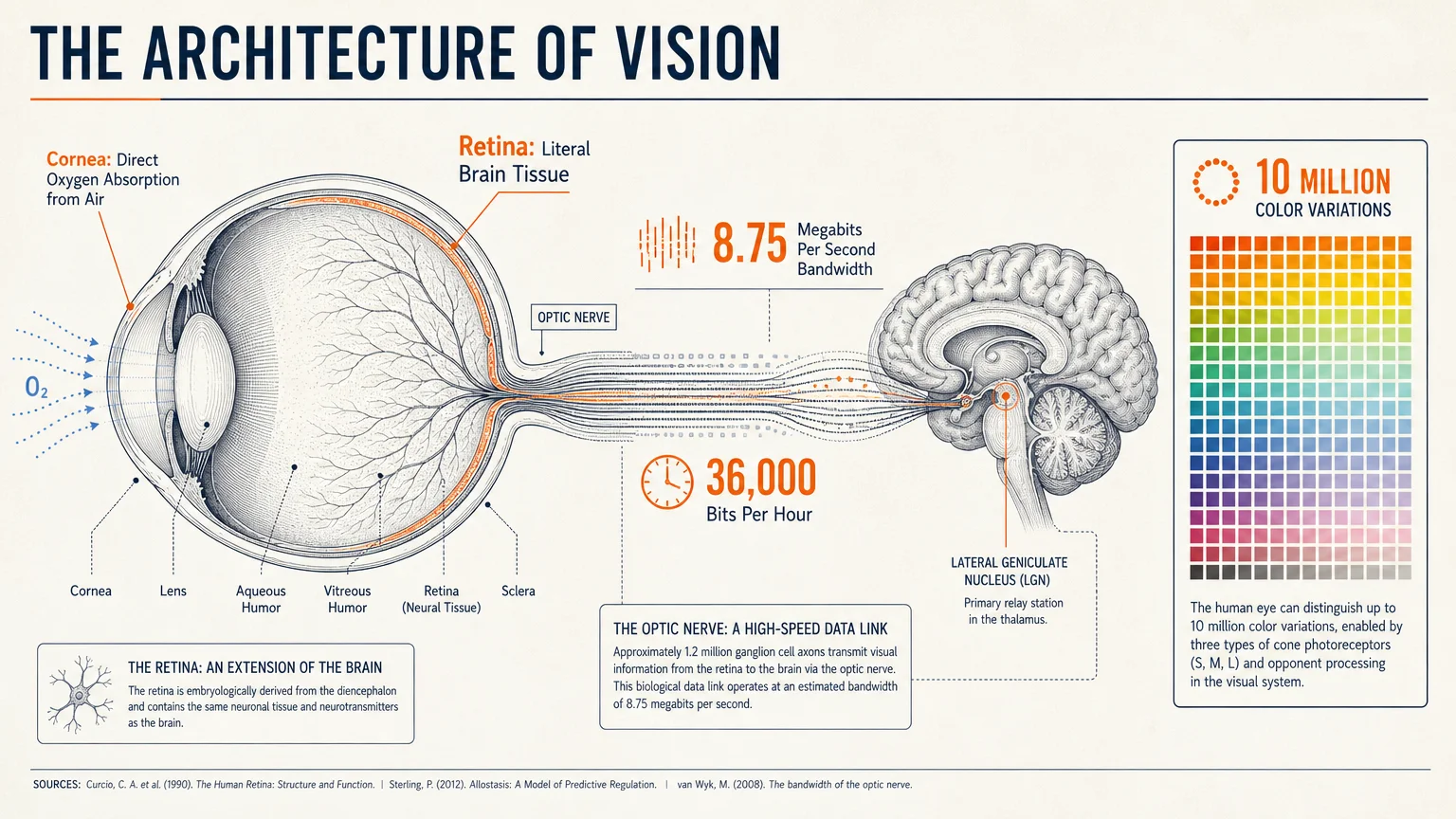
The intricate biology of your visual system contains extraordinary mechanisms that scientists are only beginning to fully map. Many people consider the eye a standalone organ, but the reality is far more integrated. Fact one: your retina is literal brain tissue. During embryonic development, the tissue that eventually forms your retina and optic nerve extends outward from the developing brain. This means when an eye doctor examines the back of your eye, they are examining a visible piece of your central nervous system. This direct physical connection explains why neurodegenerative conditions often manifest in the visual system long before memory loss or motor function declines become apparent.
Your visual hardware operates with staggering efficiency. Fact two: your optic nerve transmits data at speeds rivaling high-speed internet. Researchers quantifying the bandwidth of the human visual system found that the optic nerve transfers visual information to the brain at an equivalent rate of roughly 8.75 megabits per second. Through measurements of biological data transmission, scientists have demonstrated how retinal ganglion cells encode dynamic scenes, prioritize moving objects, and compress data before sending it along the optic nerve. You process an astonishing 36,000 bits of information every hour, allowing you to react to environmental threats in fractions of a second.
Furthermore, your capability to perceive the physical world involves extreme precision. Fact three: your eyes can distinguish roughly 10 million different color variations. This capability relies on three highly specialized types of cone cells concentrated in your macula. Subtle genetic variations alter the peak sensitivity of these cones; therefore, your experience of a specific shade of blue might be biologically unique compared to the person standing next to you. The practical takeaway here is that protecting these specialized cells from excessive ultraviolet radiation is crucial for maintaining vibrant color perception as you age. Wearing sunglasses with proper UV protection goes beyond comfort—it serves as a necessary medical shield for your retinal cells.
Even the outer surface of your eye possesses unique physiological traits. Fact four: your cornea absorbs oxygen directly from the air. Because the cornea must remain perfectly transparent to focus light accurately onto the retina, it cannot contain blood vessels. Instead, it pulls dissolved oxygen from your tear film, which continuously replenishes its supply from the surrounding atmosphere. This unique biological adaptation requires your careful attention if you wear contact lenses. Leaving standard lenses in overnight creates an impermeable barrier that suffocates the corneal cells, leading to severe infections, painful swelling, and permanent structural damage. You must always allow your eyes to breathe naturally while you sleep to maintain this delicate oxygen exchange.

The Global Impact of Changing Eye Health Patterns
How you use your eyes has changed dramatically over the last century, bringing profound global consequences for public health. Epidemiologists are currently monitoring shifting demographic patterns that reveal a widespread, unprecedented deterioration in distant vision. Fact five: myopia is rapidly becoming a global epidemic driven by modern indoor lifestyles. You might assume nearsightedness is purely genetic, but environmental factors heavily dictate the shape of your eyes. The World Health Organization monitors recent demographic shifts indicating that half the global population will experience myopia by 2050. Researchers trace this massive surge directly to children spending insufficient time outdoors. Natural sunlight stimulates the release of retinal dopamine, a vital neurotransmitter that prevents the eyeball from elongating abnormally during childhood development. Incorporating two hours of outdoor time into daily routines offers a practical, low-cost intervention to preserve the structural integrity of the developing eye across populations.
The stakes for global education and economic stability are equally high. Fact six: approximately 80 percent of all learning occurs through visual pathways. When uncorrected refractive errors persist in classrooms, educational outcomes plummet. In regions lacking robust optometric infrastructure, millions of children struggle with literacy and academic performance simply because they need basic spherical lenses. Public health initiatives bridging this gap demonstrate that providing a simple pair of corrective glasses dramatically boosts classroom engagement, literacy rates, and ultimately, lifetime earning potential within developing communities.
Your daily interaction with digital screens also alters your natural biological rhythms in subtle, surprising ways. Fact seven: blinking functions as a momentary rest state for your brain. You naturally blink about 15 to 20 times per minute, which seems excessive if the only biological goal is to lubricate the cornea. Neuroscientists conducting studies tracking neural activity discovered that the brain utilizes the microsecond of darkness during a blink to temporarily disengage from environmental stimuli. The default mode network—the specific brain region active during wakeful rest—briefly activates, allowing your mind to reset its attention span. However, when you stare intently at a computer or smartphone display, your blink rate drops by more than half. This severe reduction strips your brain of these crucial neural microsleeps, causing intense digital eye strain, dry eye syndrome, and cognitive fatigue. You can counter this modern problem by consciously practicing the 20-20-20 rule; look at an object 20 feet away for 20 seconds every 20 minutes to restore your natural blink rate and visual comfort.

Expert Voices on Oculomics and Systemic Health
The rapid emergence of high-resolution ocular imaging technology has effectively transformed the eye clinic into a frontline diagnostic center for systemic disease. Medical professionals increasingly rely on visual markers to gauge your overall physiological health. Fact eight: your pupil dilation directly reflects cognitive load and autonomic nervous system activity. While ambient light causes the pupil to constrict, intense mental effort or emotional arousal triggers your sympathetic nervous system, forcing the pupil muscles to dilate. Psychologists and neurologists actively track these minuscule pupillary fluctuations to measure exactly how hard your brain works during complex problem-solving tasks. When you look at someone you love, or when you attempt to solve a difficult mathematical equation, your pupils expand measurably, serving as a highly accurate biological gauge of your internal emotional and cognitive state.
The structural resilience of ocular tissues continually surprises the medical community. Fact nine: your cornea heals at a remarkable pace. The outermost layer of your eye is densely packed with sensitive nerve endings, making even a microscopic corneal scratch incredibly painful. Yet, thanks to a robust supply of limbal stem cells located at the peripheral edge of the cornea, minor abrasions can heal completely within 24 to 48 hours. Healthy epithelial cells rapidly migrate across the damaged surface area to seal the wound and prevent bacterial infection. You support this rapid cellular regeneration by staying well-hydrated, maintaining a diet rich in vitamin A, and actively resisting the urge to rub your eyes when a foreign object enters them.
Perhaps the most groundbreaking development in modern preventive medicine involves reading the complex vascular maps located at the back of your eye. Fact ten: routine retinal scans can reveal early markers of Alzheimer’s disease and cardiovascular failure. The emerging medical field of oculomics leverages sophisticated artificial intelligence algorithms to analyze the tiny blood vessels in the retina. Medical experts assessing massive health databases recently published an analysis of retinal imaging data demonstrating that changes in the thickness of retinal layers and the tortuosity of microvessels predict heart attacks and strokes up to seven years before traditional symptoms appear. Researchers can also identify specific amyloid-beta plaques accumulating in the retina that perfectly mirror the brain pathology of early-stage Alzheimer’s disease. By mapping these microvascular changes, your local optometrist could soon serve as the primary gateway for early neurological and cardiovascular medical interventions.
Frequently Asked Questions About Eye Care
Can blue light from screens permanently damage vision?
You constantly hear ominous warnings about the blue light emitted by digital devices, but current clinical data shows zero evidence that standard screen exposure causes permanent physical damage to your retina. The physical discomfort you feel after a long day of computer work stems directly from digital eye strain, severely decreased blink rates, and improper screen glare rather than cellular toxicity. Blue light does, however, strongly influence your internal circadian rhythm. Staring at bright screens late at night artificially suppresses melatonin production, which heavily disrupts your sleep cycle. To maintain healthy habits, you should reduce screen brightness in the evening and employ software filters that warm your display colors, but you do not need to worry about smartphones permanently blinding you.
How much outdoor time do children need to prevent myopia?
The current scientific consensus points to ambient light exposure as the primary defense against the rapid progression of nearsightedness in children. Global public health guidelines recommend that children spend at least two hours outdoors every single day to maintain healthy ocular growth. The lux levels—a scientific measure of light intensity—found even on a heavily overcast day far exceed the brightness of standard indoor artificial lighting. This intense natural daylight triggers the retinal release of dopamine, which strictly regulates the axial growth of the eyeball. Encouraging outdoor play during daylight hours offers a highly effective, natural, and completely free strategy to protect the long-term visual acuity of the next generation.
Are carrots actually the best food for eye health?
The persistent narrative that carrots guarantee perfect vision originated from a clever World War II propaganda campaign designed to hide the invention of radar technology from enemy forces. While carrots do contain beta-carotene—a vital precursor to vitamin A essential for low-light retinal function—they are not the ultimate superfood for your visual system. To actively protect your macula against age-related degeneration, you should prioritize dark leafy greens like spinach, kale, and Swiss chard. These specific vegetables are packed with lutein and zeaxanthin, powerful dietary antioxidants that naturally accumulate in the retina and safely filter out harmful high-energy light waves. Incorporating fatty fish rich in omega-3 fatty acids also prevents severe dry eye syndrome and supports the structural integrity of your visual cell membranes.
What causes the sudden appearance of eye floaters?
Those tiny dark specks, translucent cobwebs, or squiggly lines constantly drifting across your field of vision are known clinically as floaters. They occur when the vitreous humor—the clear, gel-like substance filling the large middle chamber of your eye—begins to shrink and clump together as you naturally age. These microscopic protein clumps cast distinct shadows onto your retina as light passes through the eye, which your brain perceives as floating geometric shapes. Most common floaters are entirely harmless and naturally settle out of your direct line of sight over several months. However, if you suddenly notice a massive swarm of new floaters, accompanied by bright flashes of light or a dark curtain falling over your peripheral vision, you must seek immediate emergency medical care. These severe symptoms indicate a potential retinal tear or detachment, which requires swift surgical intervention to prevent permanent vision loss.
A Forward Look at Vision Research
The scientific boundaries of ocular medicine expand daily, bringing unprecedented hope for conditions once deemed entirely incurable. You are living in an era where the dynamic intersection of biotechnology, genetic sequencing, and artificial intelligence completely redefines what is medically possible. Major regulatory agencies continue issuing regulatory approvals for genetic treatments that successfully deliver healthy genes directly into the retina to restore functional vision in patients suffering from inherited retinal dystrophies. This critical milestone in targeted gene therapy paves the way for eventually treating much broader genetic causes of progressive blindness.
Simultaneously, human clinical trials for advanced retinal prostheses—often referred to in the media as bionic eyes—are progressing at a remarkable pace. Bioengineers now actively design subretinal microchips capable of converting ambient light into electrical signals, completely bypassing damaged photoreceptors and communicating directly with the surviving optic nerve. Furthermore, cellular researchers are heavily focused on regenerating damaged optic nerve fibers, a complex biological challenge that remains the absolute holy grail of modern glaucoma treatment. While fully restoring severed neural connections between the eye and the brain remains an unsolved scientific puzzle, ongoing experiments utilizing targeted protein therapy and stem cell integration show highly promising early results in laboratory animal models.
As advanced artificial intelligence diagnostics move from university research laboratories into your neighborhood eye clinics, your routine annual eye exam will soon transform into a comprehensive physiological audit. By embracing these technological advancements and applying simple daily habits to protect your ocular health, you secure your long-term vision while gaining a powerful medical tool for monitoring your systemic wellness well into the future.